Apple before Monday: the quiet giant and its first report under a new chief
Apple reports on November 2 as the most valuable company in the world, after a month in which it rose while big tech fell. What the news says, what is expected, and how its shares have answered before.
Apple reports its July to September quarter after the close on Monday, November 2. It goes into the report as the most valuable company in the world, at about $5.0 trillion. Its shares are within 1.3% of the record close they set on Wednesday. And it will be the first results call with John Ternus as chief executive.
The setting is unusual too. In October, while the rest of big tech fell, Apple went the other way.
The quiet one in a loud month
From the close on September 30 to the close on Friday, October 30, Apple rose 3.5%. The Nasdaq 100 fund (QQQ) fell 6.7%. Nvidia fell 10.4%, Meta 15.2% and Alphabet 18.7%. Of the companies in the chart, only Microsoft also finished the month higher, by 1.8%.
Over the year Apple is up 26.8%, against 12.4% for the Nasdaq 100 fund and 10.8% for the S&P 500 fund (SPY). On Friday its market value passed Nvidia's: $5.02 trillion against $4.94 trillion at the close.
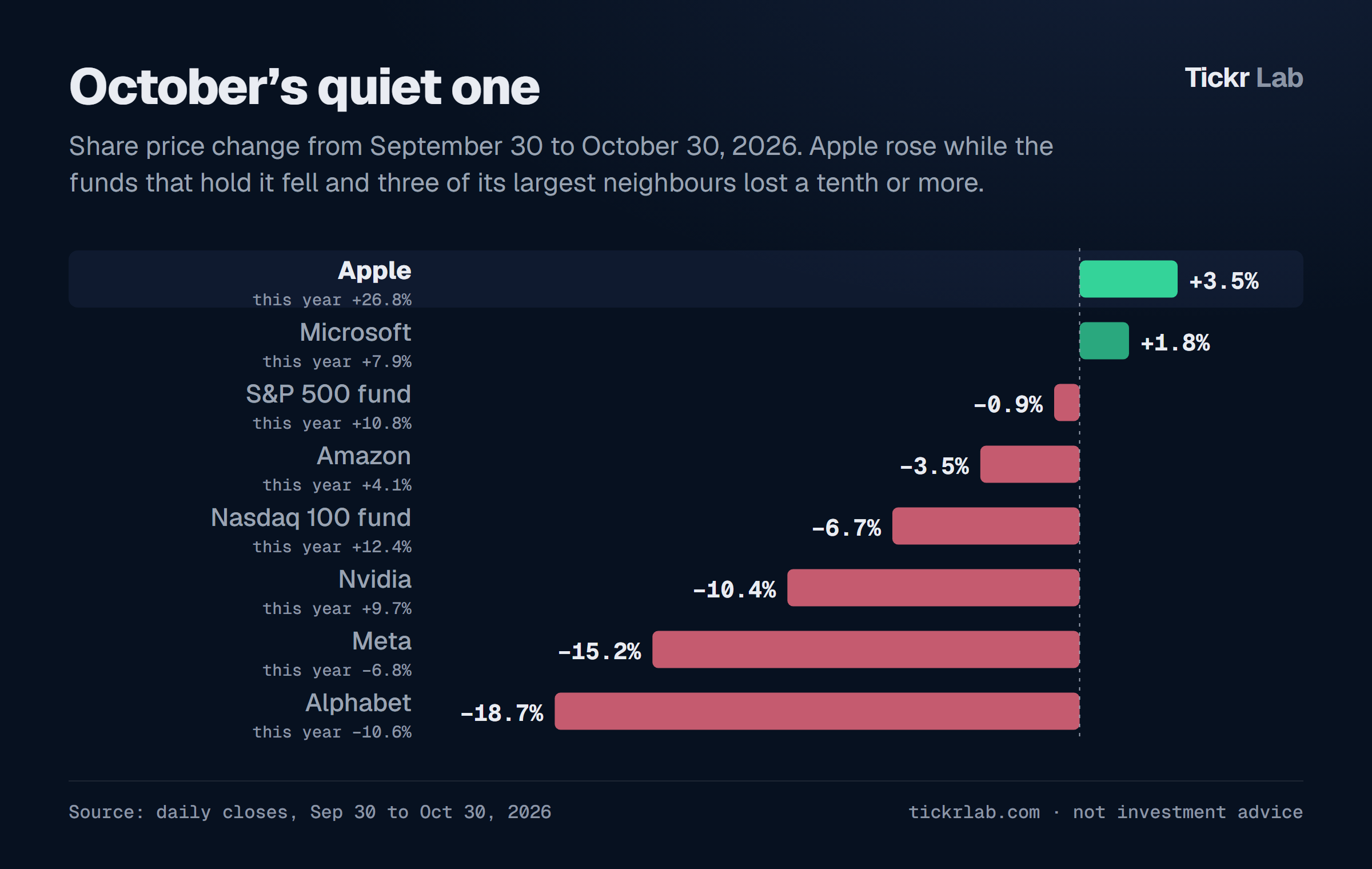
In this chart: Apple · Microsoft · SPY · Amazon · QQQ · Nvidia · Meta · Alphabet
Apple stopped moving with the Nasdaq
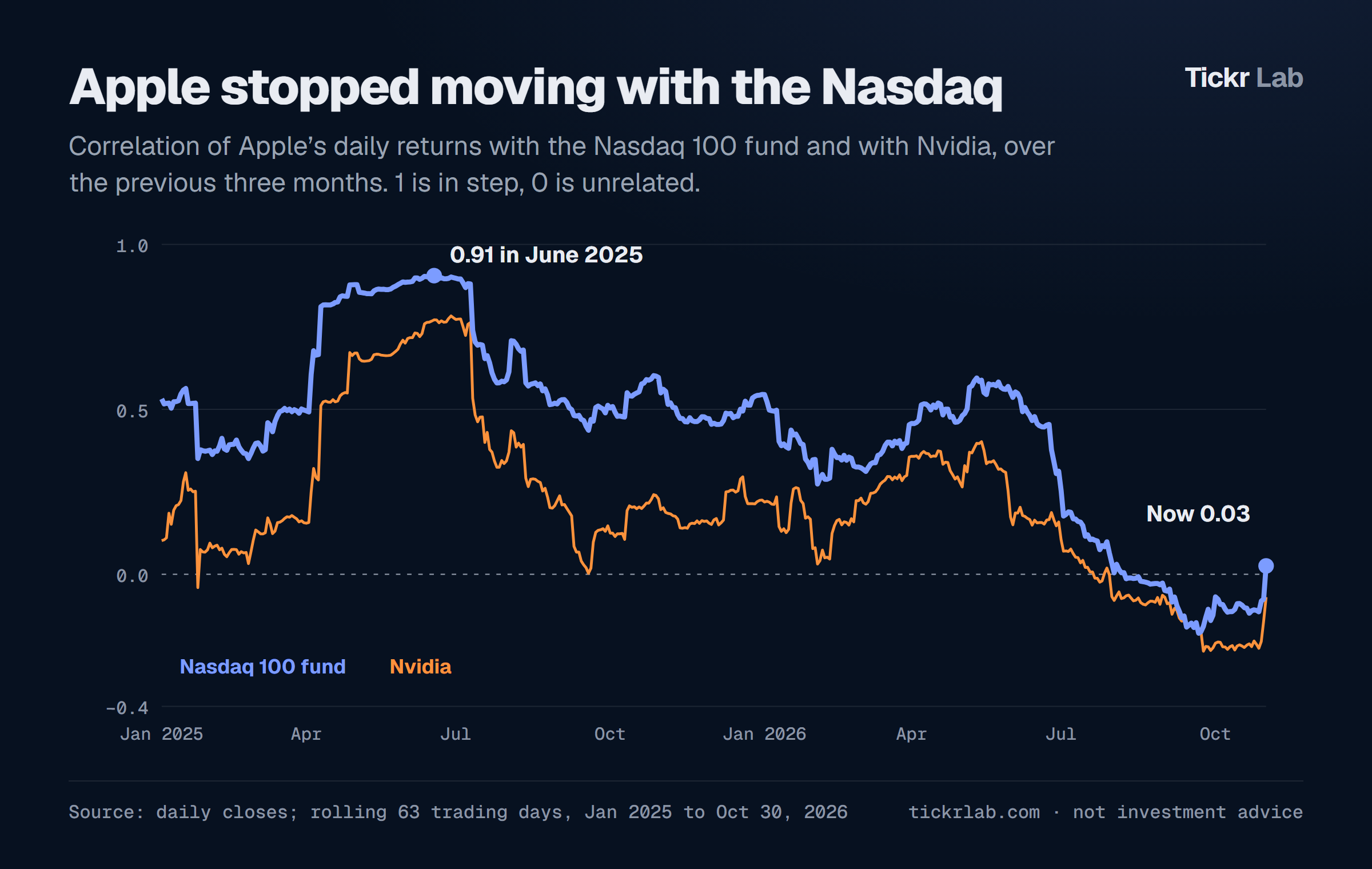
Apple is one of the largest holdings in the Nasdaq 100, so for a long time the two moved together. In June 2025, the correlation between Apple's daily returns and the Nasdaq 100 fund's over the previous three months reached 0.91, close to moving in lockstep.
That link has been fading all year. In August 2026 the correlation dropped below zero for the first time since the start of 2025. It reached −0.18 in late September, and on Friday it stood at 0.03, which means unrelated. Apple's correlation with Nvidia followed the same path. Several articles this week call Apple a hedge against the AI trade. The chart shows what that means: lately, Apple's daily moves have had almost nothing to do with the chip stocks'.
Two dollars in every hundred
One reason sits in the cash flow statements. In their latest quarters, Meta spent $53 on buildings and equipment, mostly data centres, for every $100 of revenue. Microsoft spent $43, Alphabet $40 and Amazon $38. Alphabet, Amazon and Meta all spent more than their operations brought in, so their free cash flow was negative.
Apple spent $2. In April to June, its latest reported quarter, that was $2.5 billion of spending against $31.9 billion of free cash flow. Apple runs Google's Gemini model on its devices rather than building that capacity itself. When investors started asking in October whether AI spending would pay off, Apple was the large company with the least of it.
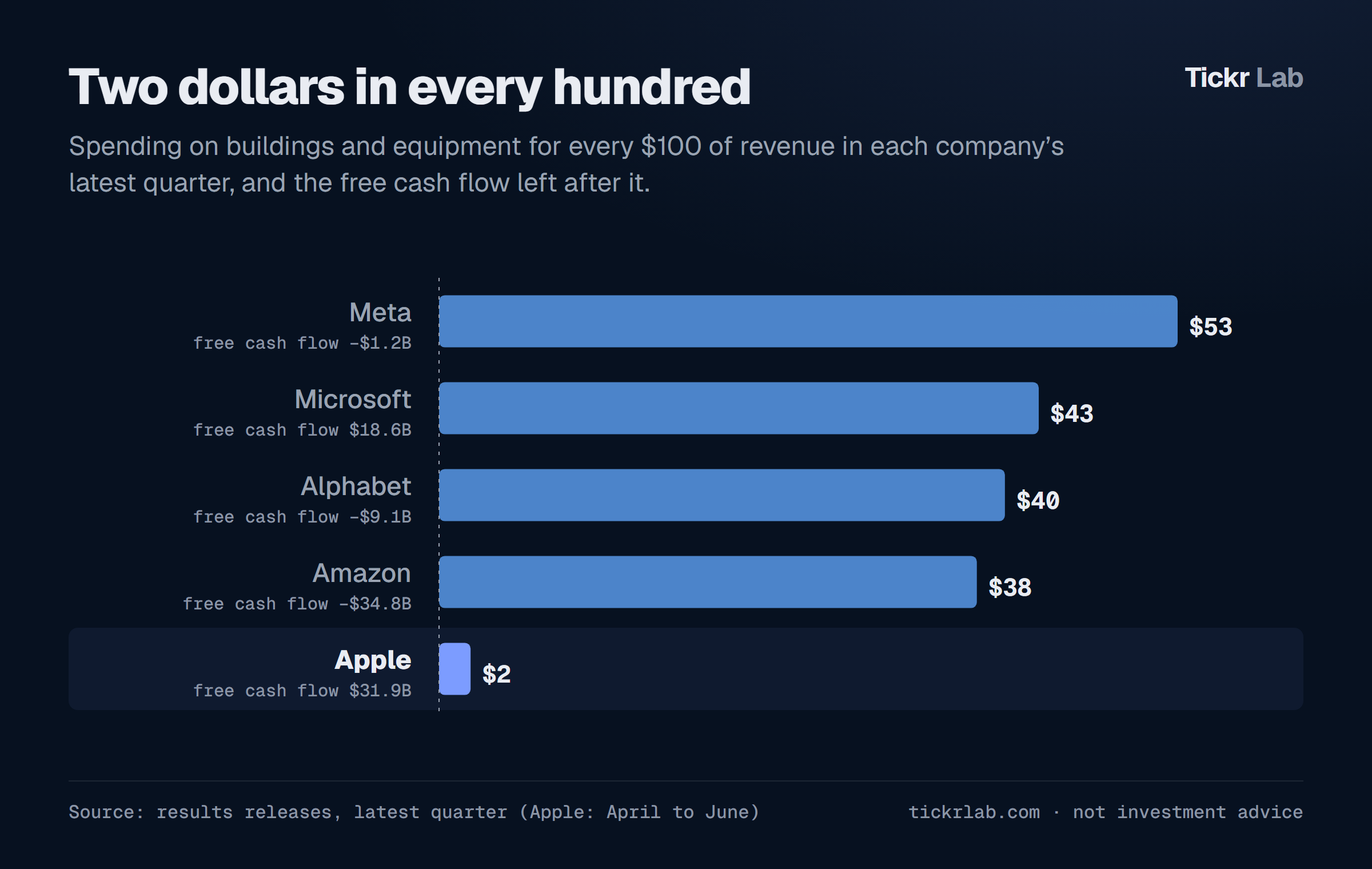
In this chart: Meta · Microsoft · Alphabet · Amazon · Apple
What the news has been saying
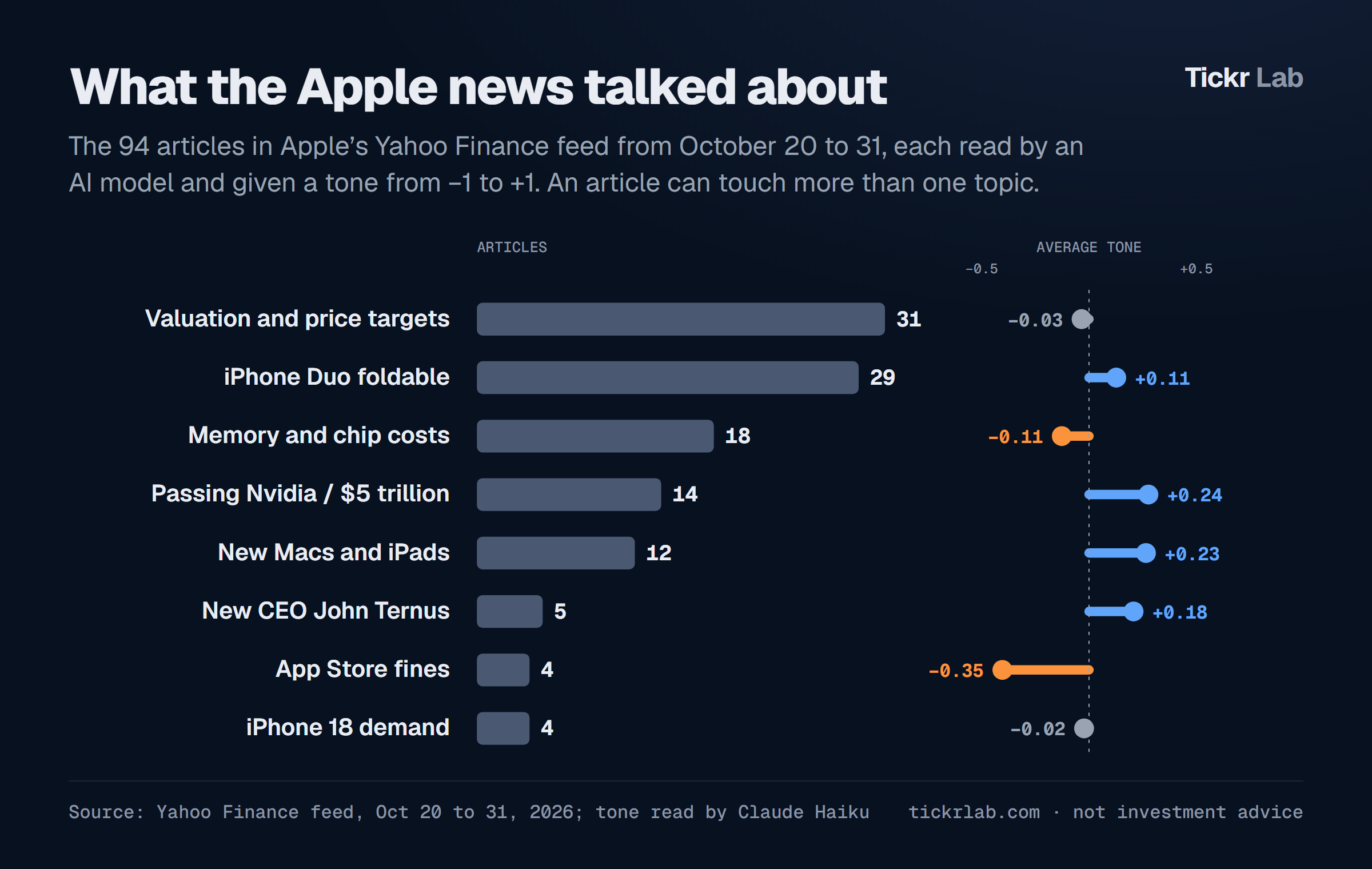
Tickr Lab reads every article in a company's Yahoo Finance feed and has an AI model give each one a tone from −1 to +1. From October 20 to 31, Apple's feed had 94 articles. 46 leaned positive, 26 negative and 22 neutral, for an average of +0.06. That is close to even, and the topics explain why:
- The iPhone Duo. This was the biggest product story, in 29 articles. Apple's first foldable phone, from $1,999, sold out on preorder, and deliveries stretched into January. Reports said Apple raised its shipment target by 44% and asked suppliers for 30% more units. Apple has not confirmed either figure. The tone turned on October 27, when owners reported cracked inner screens. Apple said a small number of units was affected and is replacing them.
- Passing Nvidia (+0.24) and the new Macs and iPads (+0.23) were the most positive topics. These included the first touchscreen MacBook Pro, from $2,899, announced on Wednesday.
- Memory costs (−0.11, 18 articles) were the main worry. AI data centres are buying up memory chips and pushing prices up for everyone else. Apple raised MacBook Pro prices by $300 in June because of a memory and storage shortage, and Bank of America expects the costs to show up in gross margin.
- Valuation was the largest topic, with 31 articles split almost exactly between positive and negative. Apple trades at about 36 times expected earnings, against 22 for Microsoft, 21 for Alphabet, 24 for Amazon, 18 for Meta and 13 for Nvidia. Several articles noted that analysts' average price target sits below the share price.
- App Store fines in South Korea (−0.35) were the most negative topic, though the fines were small.
What is expected on Monday
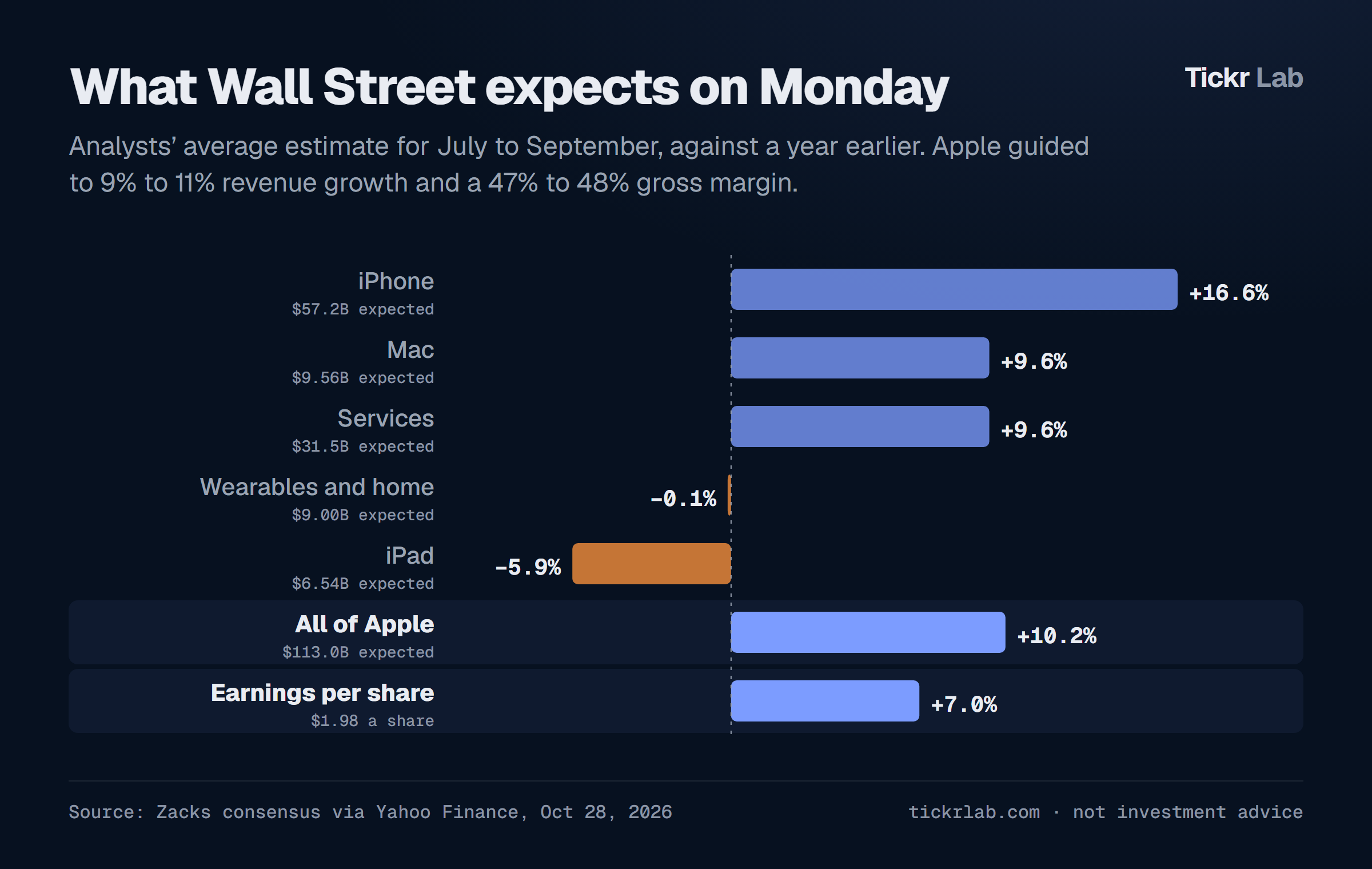
In July, Apple guided to revenue growth of 9% to 11% for this quarter and a gross margin of 47% to 48%. That included about one point from tariff refunds. Analysts' consensus, as compiled by Zacks, sits near the top of that range: revenue of $112.95 billion, up 10.2%, and earnings of $1.98 a share, up 7%.
Four things will matter more than whether those numbers are hit:
- Gross margin. Last quarter's was 50.1%, but about two points of that came from tariff refunds. The guidance already allows for a lower figure. The question is how much memory costs take on top of that, and what Apple says about the December quarter.
- The iPhone, minus the Duo. The Duo went on sale on October 23, after this quarter ended, so none of its sales are in Monday's figures. This quarter holds the first weeks of the iPhone 18. Jefferies reported shorter delivery times and component order cuts for the iPhone 18 Pro. The Duo shows up only in what Apple says about October to December.
- Services. Analysts expect 9.6% growth. On the consensus figures, services keep about 75 cents of each dollar as gross profit, against about 37 cents for products. That is why regulators' pressure on App Store fees, like this week's fines in South Korea, gets watched closely.
- The new chief executive. This is the first call with John Ternus in charge after Tim Cook's fifteen years. How he talks about AI spending, prices and the Duo will be heard as a statement of direction.
How the shares have answered before
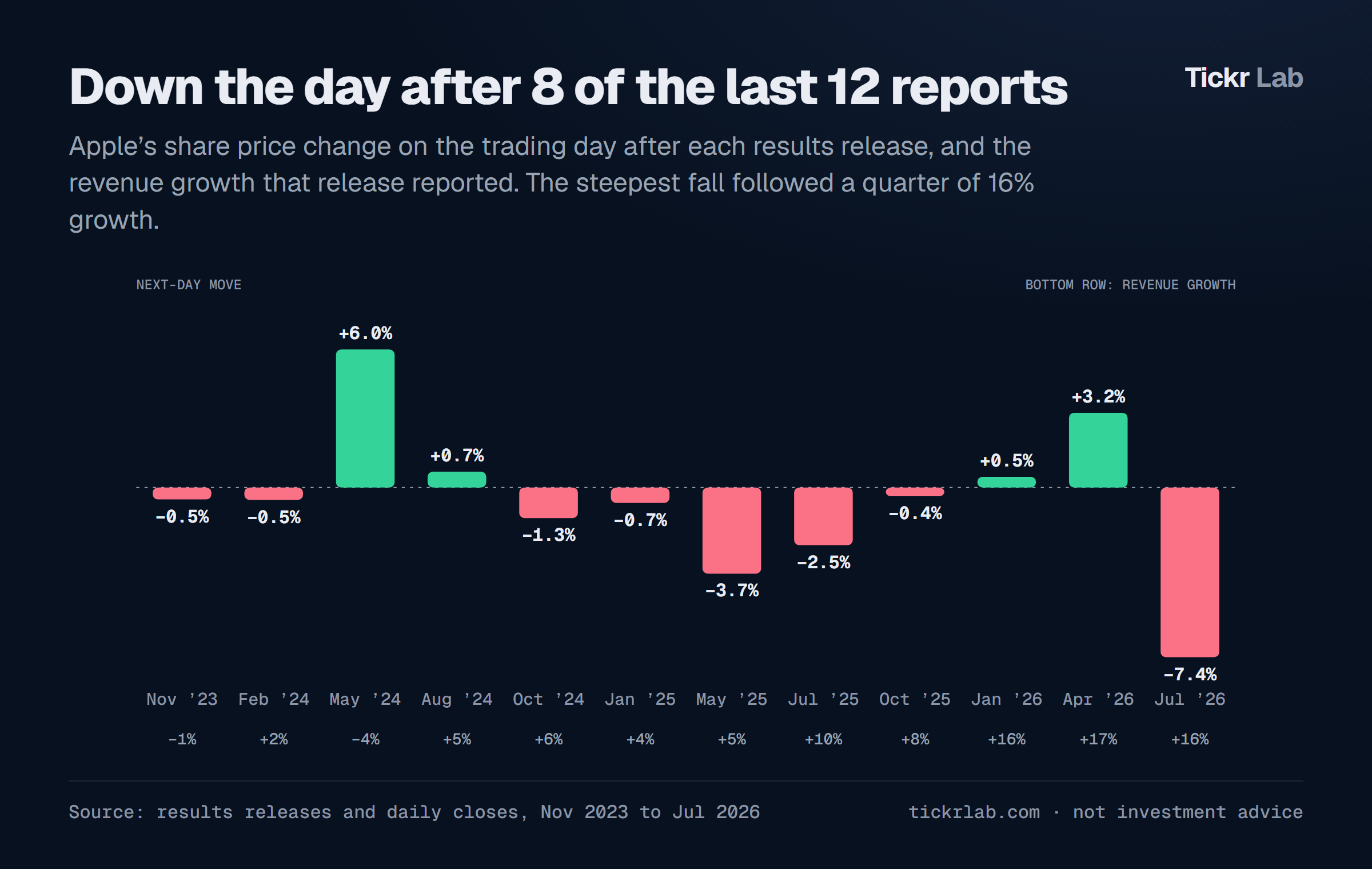
Good numbers have not been enough for Apple lately. Its shares fell on the trading day after 8 of its last 12 results releases. The biggest fall came in July: revenue up 16.4%, earnings per share up 29%, and the shares down 7.4% the next day while the Nasdaq 100 fund rose 0.7%. The typical next-day move over those twelve reports was about 1% either way. July shows that a strong quarter can still bring a much bigger fall.
Apple goes into Monday on a different footing from its neighbours. It has a record share price, a market value at the top of the world, little AI spending to defend and a stock that no longer moves with the rest of tech. What it does not have is a cheap valuation. Tuesday's trading will be the first answer, and as July showed, the answer does not always follow the numbers.
None of this says where Apple's shares go next. It is the setting for the report, measured the same way Tickr Lab measures every company.
Share prices are daily closes to October 30, 2026. Correlations use 63 trading days of daily returns. Spending and cash flow are from each company's latest results release; Apple's latest is April to June, the others' July to September. Consensus figures are Zacks's, as published on Yahoo Finance on October 28. Tone is Tickr Lab's reading of Apple's Yahoo Finance feed from October 20 to 31; an article can touch more than one topic.