S&P 500 earnings season: profits up 31%, and who added them up
S&P 500 net income is set to rise 31% on a year earlier in the September quarter, counting consensus estimates for the companies still to report. Micron and Nvidia are over a third of it. 159 companies raised guidance and 20 lowered it.
S&P 500 companies are reporting their September quarter, and most are done: between Thursday, September 10 and Saturday, November 7, 443 of the index’s 500 companies put out results for quarters that ended between August and October. To see the whole season, we added up the net income each one reported, filled in the companies still to come at what analysts expect them to earn, and set it all beside the same quarter a year earlier.
- Net income: $753 billion, up 30.6% from $577 billion, across 495 companies. 441 of them have reported; 54 are at consensus estimates, Nvidia, Broadcom, Walmart, Cisco and Home Depot among them.
- 339 of the 495 earned more than a year earlier, or are expected to: about seven in ten.
- Revenue: up 13.0% in the 408 releases out so far that state it (most banks do not report a single revenue line).
Who added up the growth
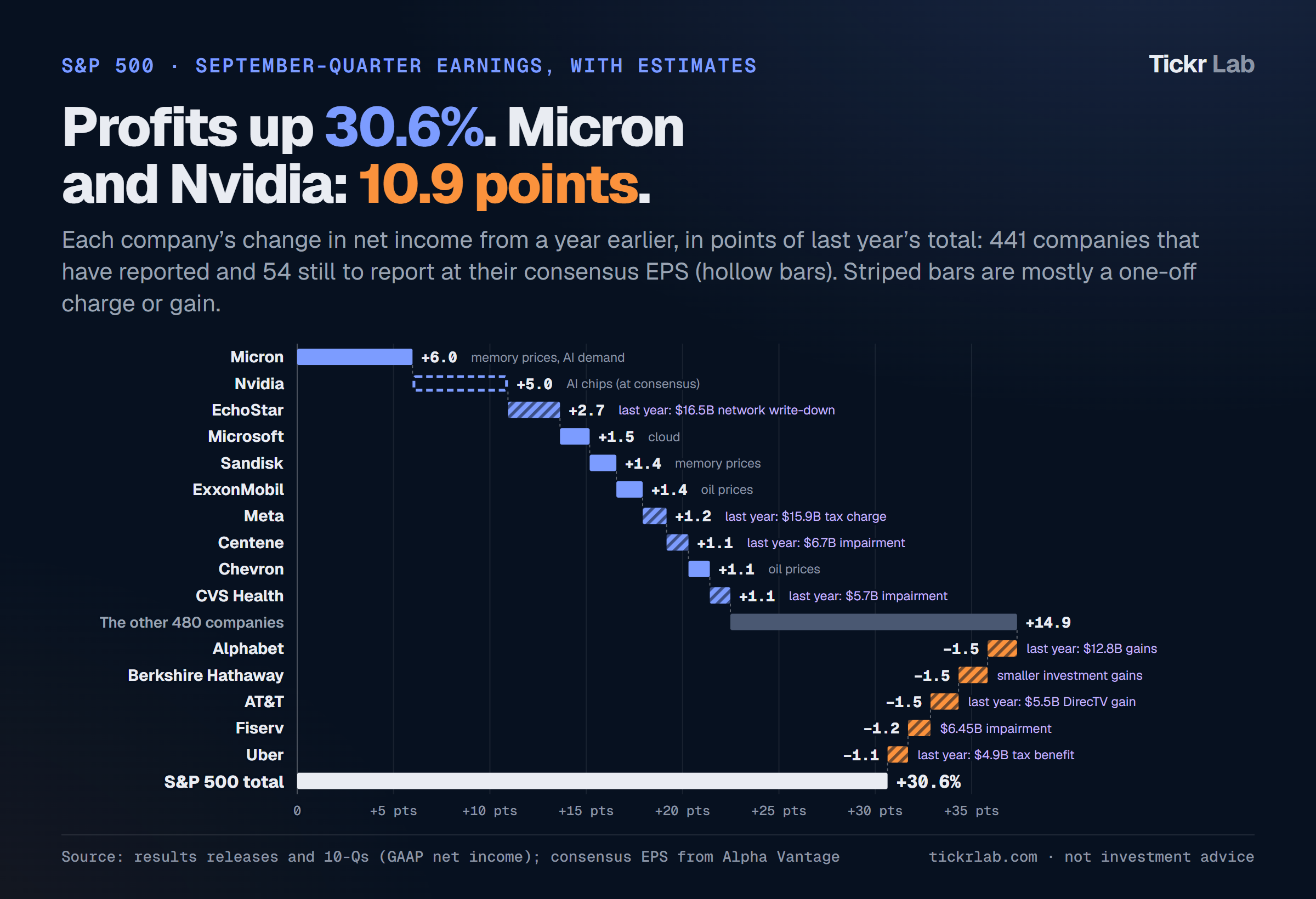
The chart breaks the 30.6% into its parts. Each bar is one company’s change in net income, in points of last year’s total, and the bars add up to the index figure. Hollow bars are companies still to report, at their consensus estimate.
In this chart: Micron · Nvidia · EchoStar · Microsoft · Sandisk · ExxonMobil · Meta · Centene · Chevron · CVS Health · Alphabet · Berkshire Hathaway · AT&T · Fiserv · Uber
- Memory. Micron earned $37.7 billion in its quarter to September 3, against $3.2 billion a year earlier, on revenue of $54.2 billion (was $11.3 billion). That is 6.0 of the 30.6 points, the largest single step. Sandisk adds another 1.4: $8.1 billion of net income against $0.1 billion.
- Nvidia, still to come. Analysts expect $2.49 a share when it reports on Tuesday, November 17: about $60 billion of net income against $31.9 billion a year earlier, or 5.0 points. Micron and Nvidia together are 36% of the season’s growth; without them the rest grow 21%. If Nvidia comes in 10% above or below the estimate, the season lands between 29.6% and 31.7%.
- Broadcom adds less than you might think: 0.9 points. The $3.45 a share expected on Thursday, December 10 is an adjusted figure; under GAAP, which counts the amortization of its acquisitions, it is about $13.5 billion against $8.5 billion.
- Oil and refining. ExxonMobil earned $15.4 billion (was $7.5 billion) and Chevron $9.9 billion (was $3.5 billion). The refiners Marathon Petroleum, Valero and Phillips 66 together earned $19.9 billion, against $2.6 billion a year earlier.
- The cloud. Microsoft earned $36.6 billion, up 32%, with Azure revenue up 48%.
- Last year’s charges falling away (striped bars). Some of the biggest rises are a one-off a year ago that did not repeat. EchoStar lost $12.8 billion a year ago, after a $16.5 billion write-down of its 5G network, and earned $2.8 billion this quarter, helped by a gain on selling spectrum to AT&T. Meta took a $15.9 billion tax charge in its 2025 quarter. Centene had a $6.7 billion goodwill impairment and CVS Health one of $5.7 billion.
- The falls are mostly one-offs too. A year ago, Alphabet booked $12.8 billion of gains on its investments, AT&T a $5.5 billion gain on selling DirecTV, and Uber a $4.9 billion tax benefit. Berkshire Hathaway earned $22.1 billion against $30.8 billion, as its investment gains fell to about $9.4 billion from $17.3 billion; its operating earnings fell 6%. This quarter, Fiserv wrote down $6.45 billion of goodwill and Johnson & Johnson took a charge for its proposed talc settlement. Alphabet’s revenue rose 25%.
- Not every company still to report is expected to grow. Walmart and Marvell are set against year-ago quarters that included large one-off gains, and Salesforce’s expected figure is below last year’s.
Net income here is as reported, under GAAP (US accounting rules), one-offs included. That is why the striped bars are shown rather than removed. The estimates are expectations, not results: companies often report above the consensus, and a single charge or gain can move a GAAP figure a long way.
By sector
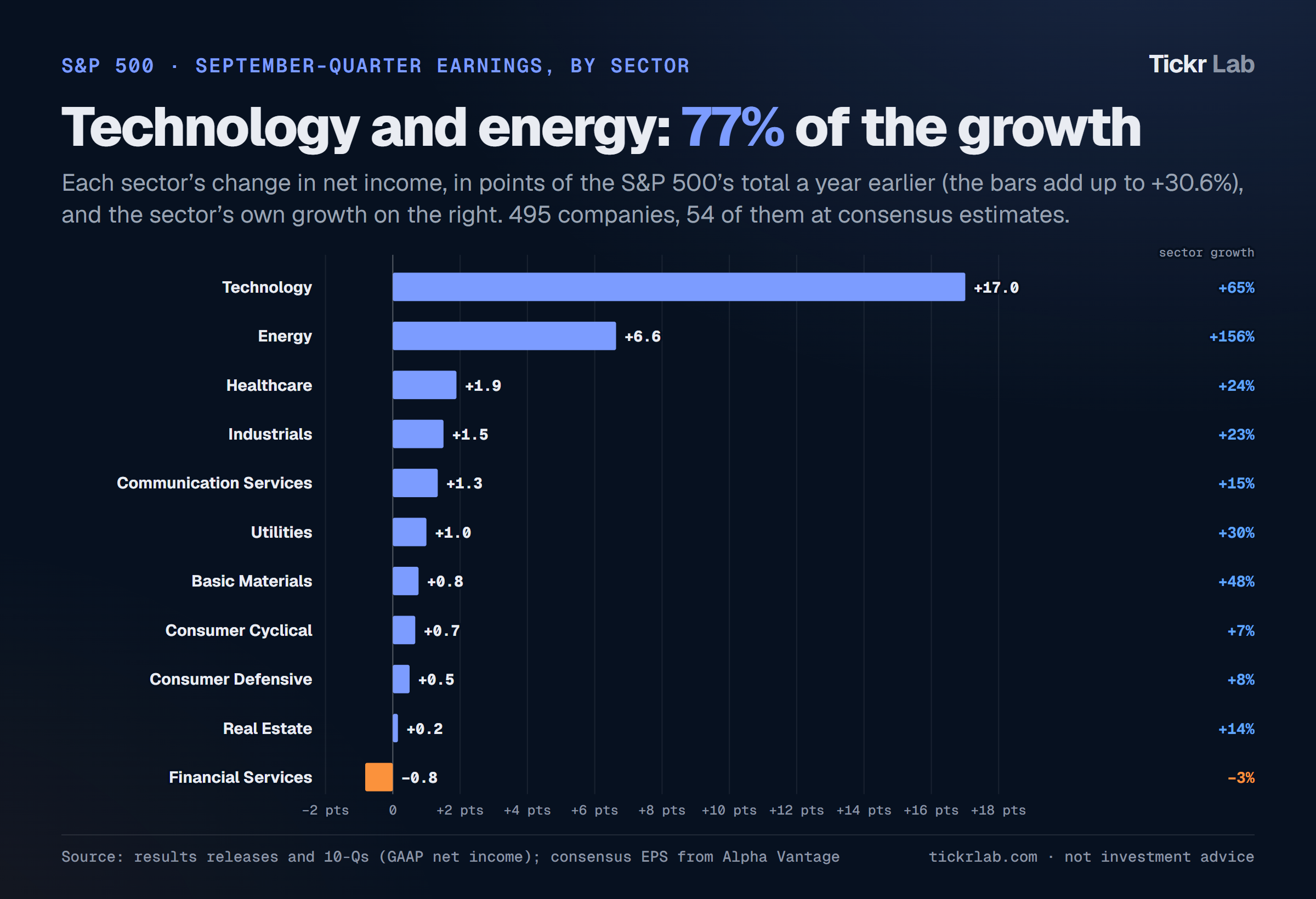
Technology (+65%) and energy (+156%) account for 23.6 of the 30.6 points, about three quarters. Communication services is up 15% only because of EchoStar: without it the sector is down 12%, with Alphabet and AT&T measured against last year’s gains and Charter taking a $6.3 billion impairment. Financial companies are the one sector down, by 3%: Berkshire’s smaller investment gains, and a $1.1 billion loss at Apollo (it earned $1.7 billion a year ago), mainly from unrealized losses on investments in its retirement business that it tied to higher interest rates.
Guidance
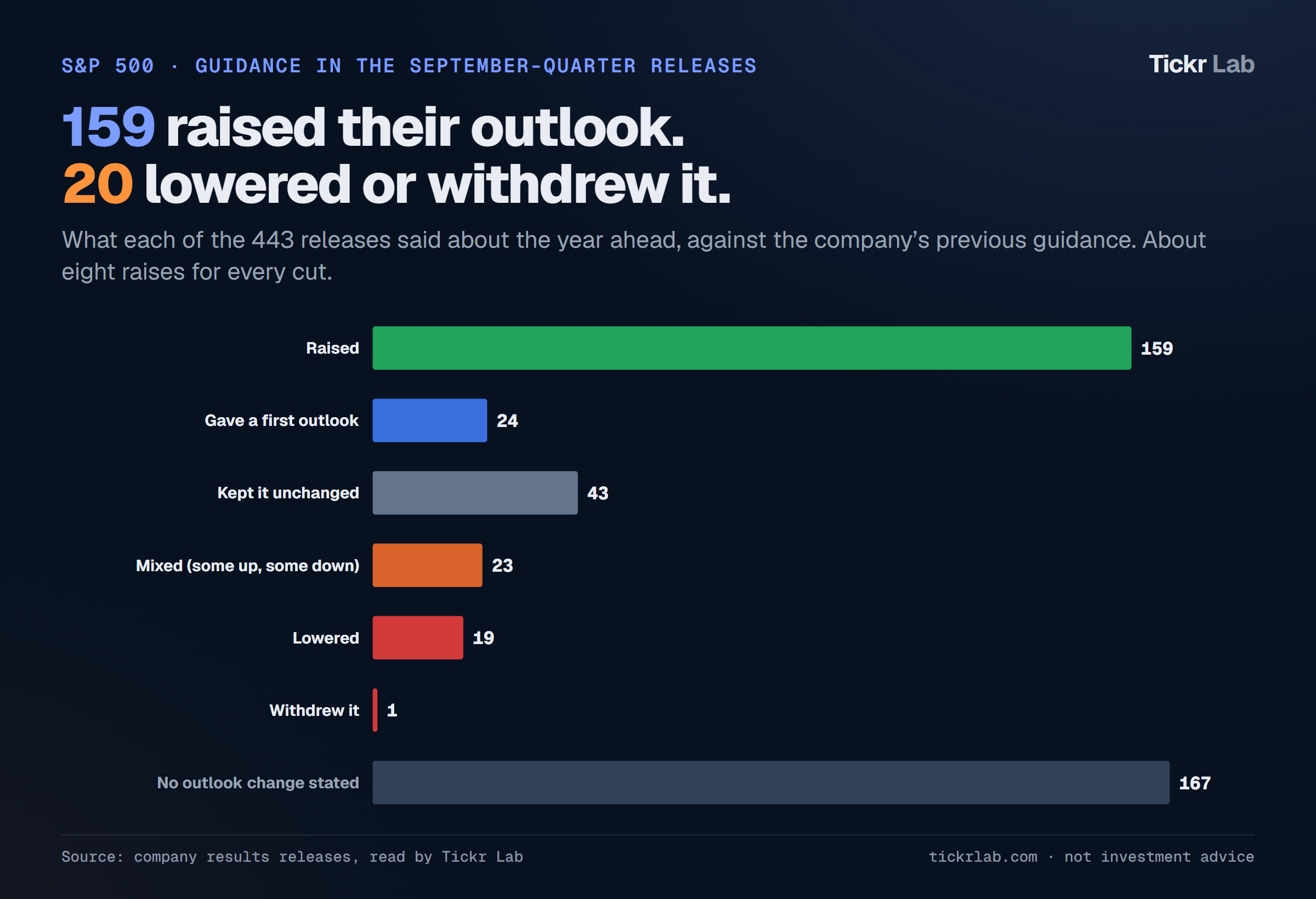
Each of the 436 results releases had its outlook set against the company’s previous guidance. 159 raised it and 20 lowered or withdrew it, about eight raises for every cut. Another 24 gave a first outlook and 43 kept theirs unchanged. 167 releases gave no outlook change we could compare: many companies give guidance only on the call, or once a year.
- Raised: among the largest, Johnson & Johnson, AbbVie, Palantir, Coca-Cola, Merck, UnitedHealth, GE Aerospace (“raising our 2026 guidance across the board”), RTX and Amgen.
- By sector: health care had 37 raises and 2 cuts, industrials 34 and 6, technology 25 and 5.
- Lowered: Southwest Airlines cut its adjusted EPS range to $2.60–2.85 from $3.25–4.25. Lennox cut to $21.00–21.50 from $23.00–24.00. Cummins pointed to “weaker than expected pickup truck demand”. Boston Scientific, Stryker and FIS trimmed theirs. Some of the 19, such as Ecolab and Cognizant, only narrowed a range so that one end came down.
- Withdrew: PTC said it is no longer providing quarterly or annual guidance.
What the releases talked about
We read the full text of every release in our archive and counted the share that mention each topic. The legal boilerplate (the forward-looking statements and risk lists) and the tables were left out. Each company is compared with its own release a year earlier, which covers 429 companies. Companies with no results release, such as Berkshire, are not in this count.
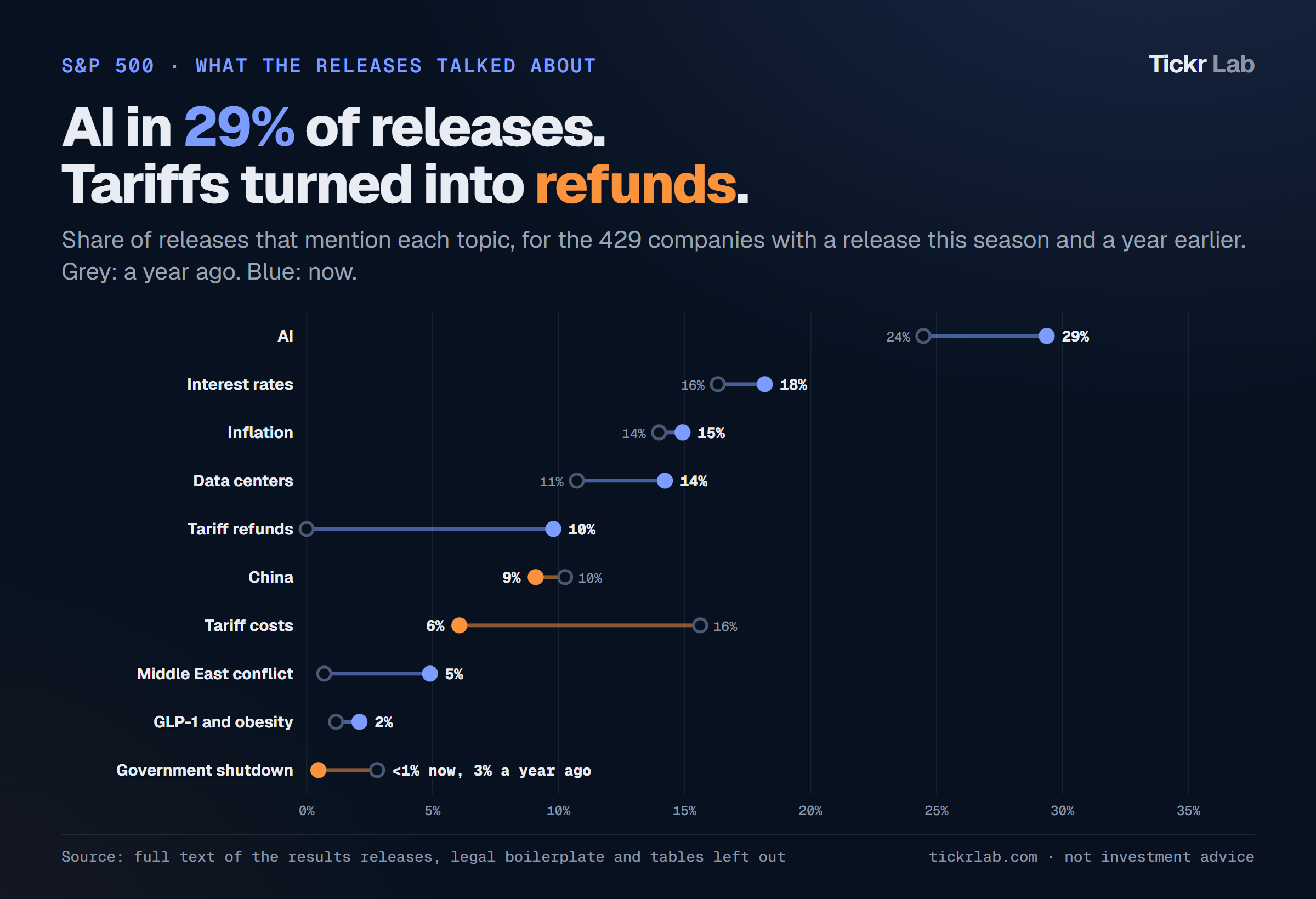
- AI: 126 of the 429 releases (29%), up from 105 a year ago. Alphabet: Google Cloud revenue “increased 103% to $30.7 billion, led by strong growth in Google Cloud Platform (GCP) across enterprise AI infrastructure and enterprise AI solutions”. Meta: “we expect to continue investing aggressively to support both our core business and emerging AI initiatives”. Micron headlined “AI-driven demand”.
- Data centers: 14%, up from 11%, and not only from chip makers. Intel had its “strongest data center revenue growth in 15 years”. Caterpillar sold more turbines and large engines, “primarily in data center applications”.
- Tariffs became refunds. A year ago 16% of releases talked about tariffs as a cost; now 6% do. Meanwhile 42 releases (10%) reported refunds of the IEEPA tariffs that the Supreme Court struck down, and none could a year ago. Apple: gross margin included “a favorable impact of approximately 1 percentage point from tariff refunds”. Costco: $0.15 a share. PepsiCo: a 4-point lift to core operating profit. Caterpillar: $128 million.
- The Middle East conflict: 21 releases (5%), against 3 a year ago. Chevron and ConocoPhillips produced less because of it. Booking’s guidance assumes its effect on travel lasts to the end of the year. Marriott said trends in the region “improved meaningfully” from the second quarter.
- The government shutdown of October 2025 came up in 12 releases a year ago and 2 now.
Interest rates (18%), inflation (15%) and China (9%) were mentioned about as often as a year ago.
How we counted
- One results release per company: the latest filed from September 10 to November 7 for a quarter ending August 1 to October 31. Companies with two share classes are counted once.
- Seven companies are counted from their 10-Q or a release our reader did not take as results: Berkshire Hathaway (its November 7 release), Apollo, EchoStar, BXP, AES, Bio-Techne and Franklin Resources.
- Net income is the GAAP figure attributable to shareholders, as each release states it.
- Where a release left it out, we took it from the company’s 10-Q, and last year’s figure from the prior-year release. ExxonMobil compares with the previous quarter, so its third quarter of 2025 ($7.5 billion) is its 2025 year-to-date earnings less the first half.
- Two companies have no comparable figure and are left out of the totals.
- The estimates: each company’s consensus earnings per share from Alpha Vantage’s calendar, as of November 8, times its diluted shares in its last release. Most consensus figures leave out items that GAAP counts, so each is scaled by the company’s own GAAP-to-adjusted ratio over its last four releases, capped at 1. Three companies have no estimate or no year-ago figure and are left out: Vivmark Residential, Vylor and Ferguson.
- Guidance labels and topic counts cover the 436 results releases out so far, and come from our reading of the release text, not the call. A topic counts once per release, however often it comes up.
What this is, and is not
A count of what one quarter’s releases reported and said, and, for the companies still to come, what analysts expect. Totals in dollars are dominated by the largest companies, and a few one-off items move them a long way, as the striped bars show. The estimates are there to show the whole season; the rest describes what happened, not what happens next.