Fire & Safety, a deep dive in the data
Nine fire and safety companies in Tickr Lab’s own data: six years of prices against the S&P 500, what results days and outlooks did to the shares, the tone of their news, short sellers, insiders and options, their worst falls, and the Signal today.
Our first post on fire and life safety looked at the industry the way a private equity buyer would. This one stays inside Tickr Lab's own data: daily prices, the results releases every company files with the SEC, the articles in each company's news feed, short interest, insider filings, options and the Signal. It covers the nine listed companies in the Fire & Safety theme: APi Group, Johnson Controls, Allegion, MSA Safety, ADT, Federal Signal, Brady, Napco Security and Resideo.
The price, over six years and year by year
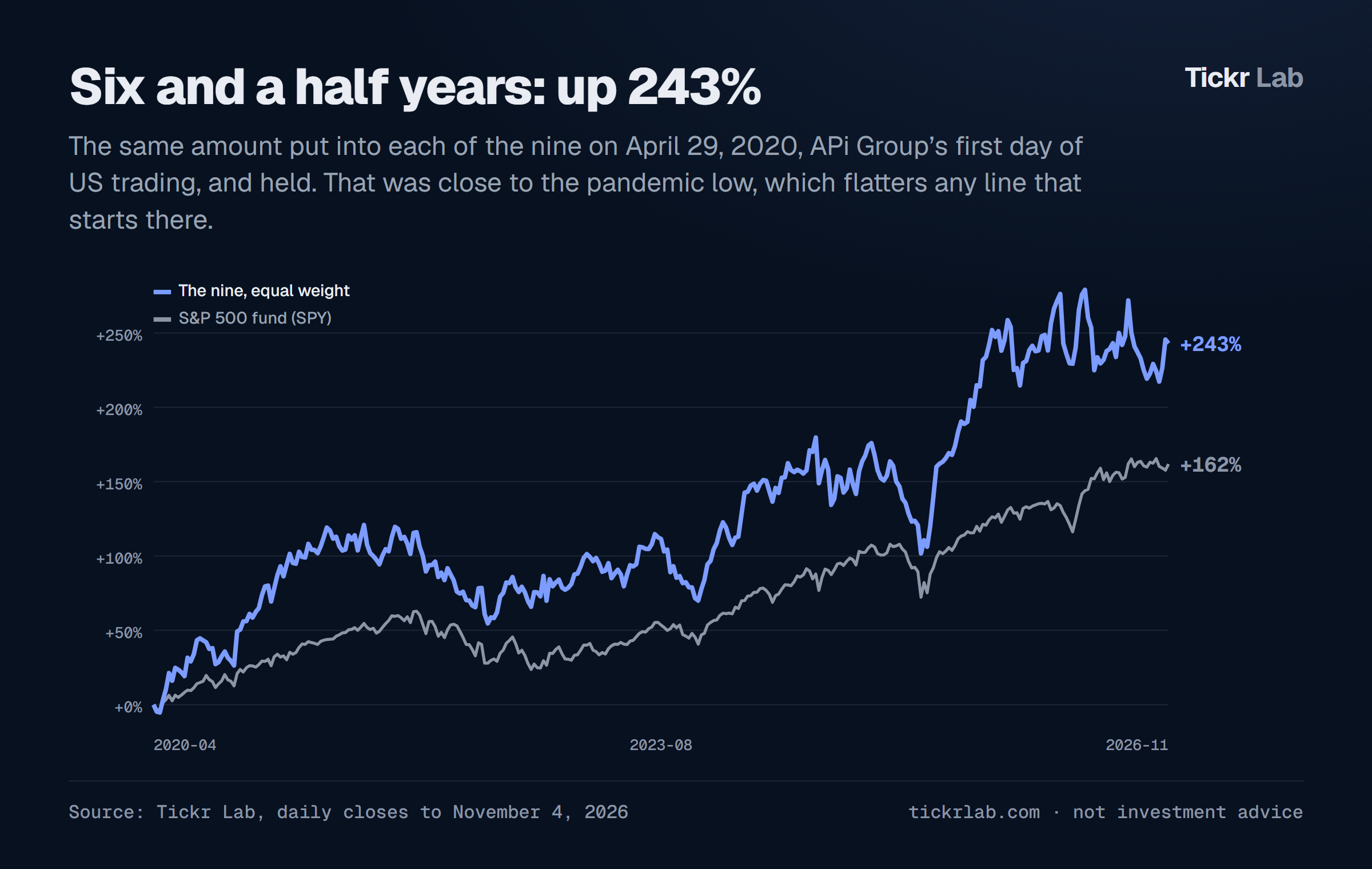
The same amount put into each of the nine on April 29, 2020, the day APi Group began trading in the US, and simply held, would be up 243% by November 4, 2026. The S&P 500 fund rose 162% over the same days. Two things flatter the number. The start was close to the pandemic low, so everything that began there rose a long way. And equal amounts held without rebalancing let the biggest risers grow into the biggest weights: APi is up 549% from that day, Resideo 464% and Johnson Controls 356%, while MSA Safety is up 64% and ADT 70%.
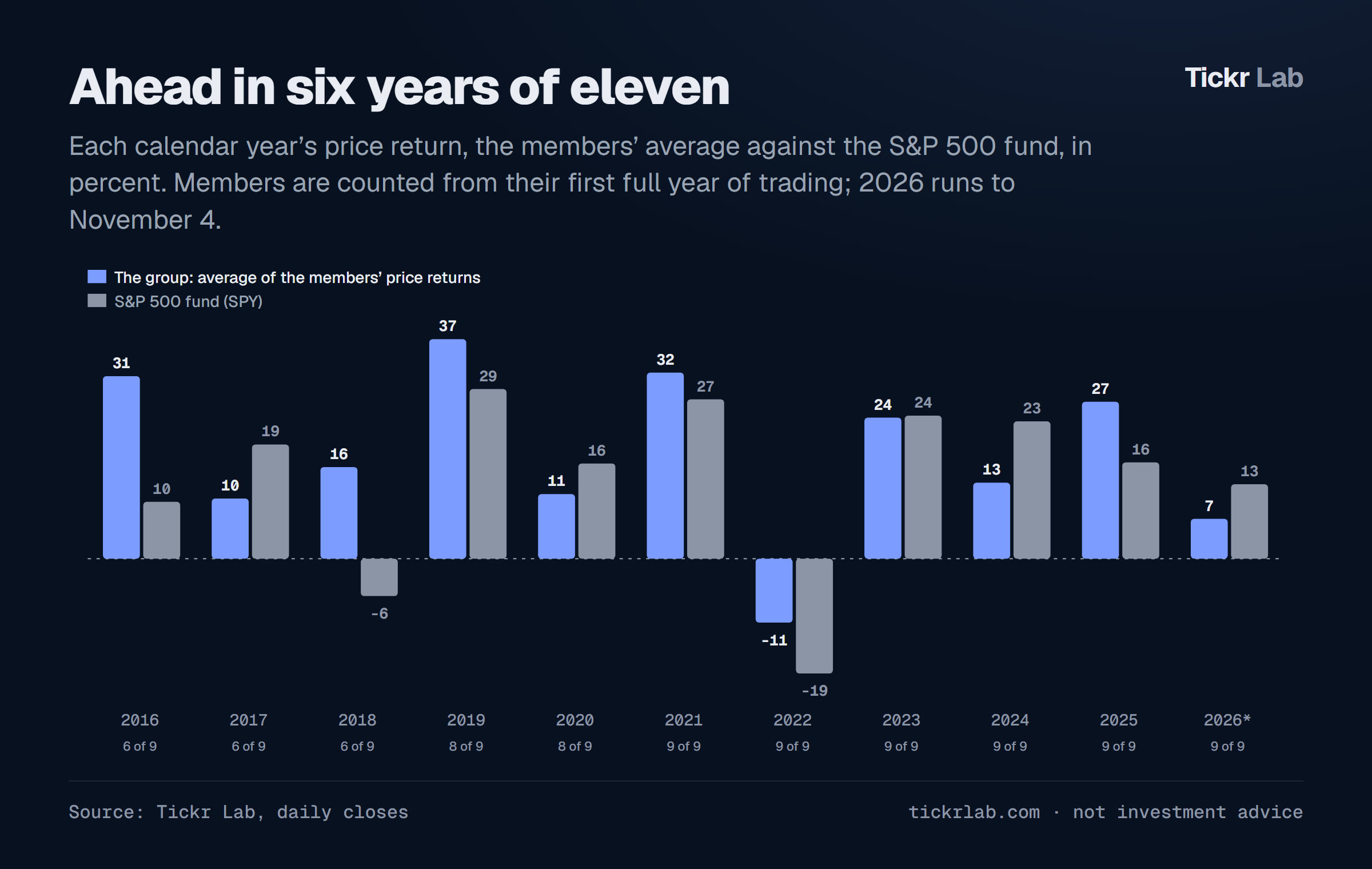
Year by year the picture is less one-sided. Taking each year's average of the members' price returns, the group finished ahead of the S&P 500 fund in six of the eleven years from 2016. It held up best in falling markets: in 2018 it rose 16% while the fund lost 6%, and in 2022 it lost 11% against the fund's 19%. It lagged in the strong years for large technology companies, 2024 (13% against 23%) and so far in 2026 (7% against 13%), and was level in 2023. That pattern, steadier in bad years and behind in the best ones, fits businesses whose revenue comes from inspections and service that customers have to pay for.
What results days do to the price
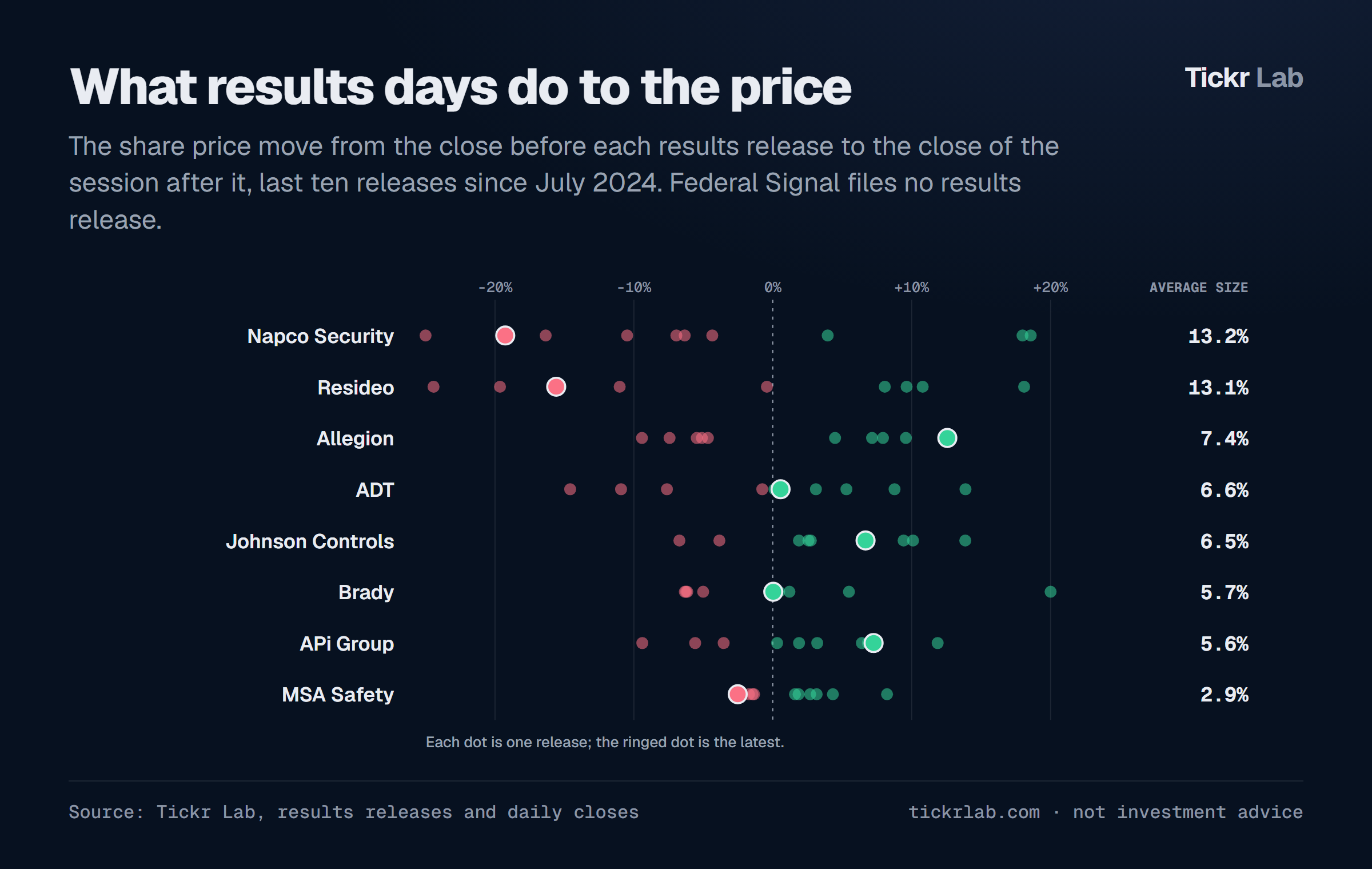
Tickr Lab reads every results release these companies file. Measured from the close before each release to the close of the session after it, the last ten releases moved the shares by very different amounts.
- Napco Security and Resideo moved most, by about 13% on average in either direction. Napco's latest release, on November 2, was followed by a 19.3% fall: revenue rose 1.7%, with recurring service revenue up 11.5% and equipment sales down 7.3%. Resideo's, on August 12, its first after spinning off its distribution business, was followed by a 15.6% fall.
- Allegion's latest, on October 22, was followed by a 12.6% rise, its largest of the ten, after it raised its outlook for the year.
- APi Group rose 7.3% after its October 29 release (revenue up 22.5%, outlook raised) and Johnson Controls 6.7% after its October 27 release.
- MSA Safety moves least, 2.9% on average; its latest was a 2.5% fall.
- Federal Signal files no results release as an 8-K, so it has no dots.
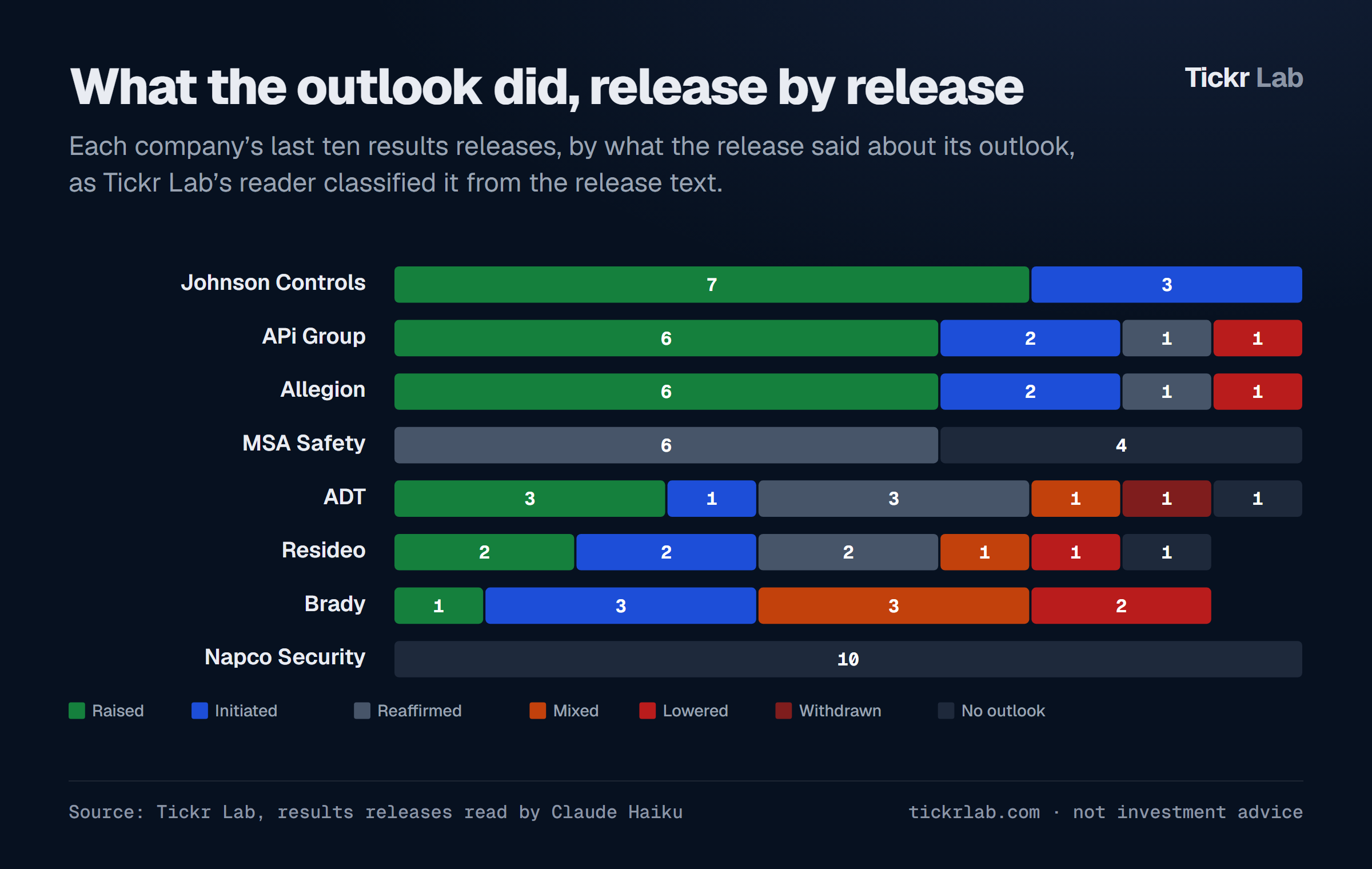
The releases also show how each company talks about the future. Johnson Controls raised its outlook in seven of its last ten releases and set a new one in the other three; APi Group and Allegion raised in six, and each lowered once. MSA Safety reaffirmed in six and gave none in four, which fits its small moves. Napco Security gave no outlook in any of the ten, and has the largest moves: with no guidance to anchor expectations, each report carries more news. ADT's withdrawn outlook is its latest release, after it agreed to be taken private.
What the articles said
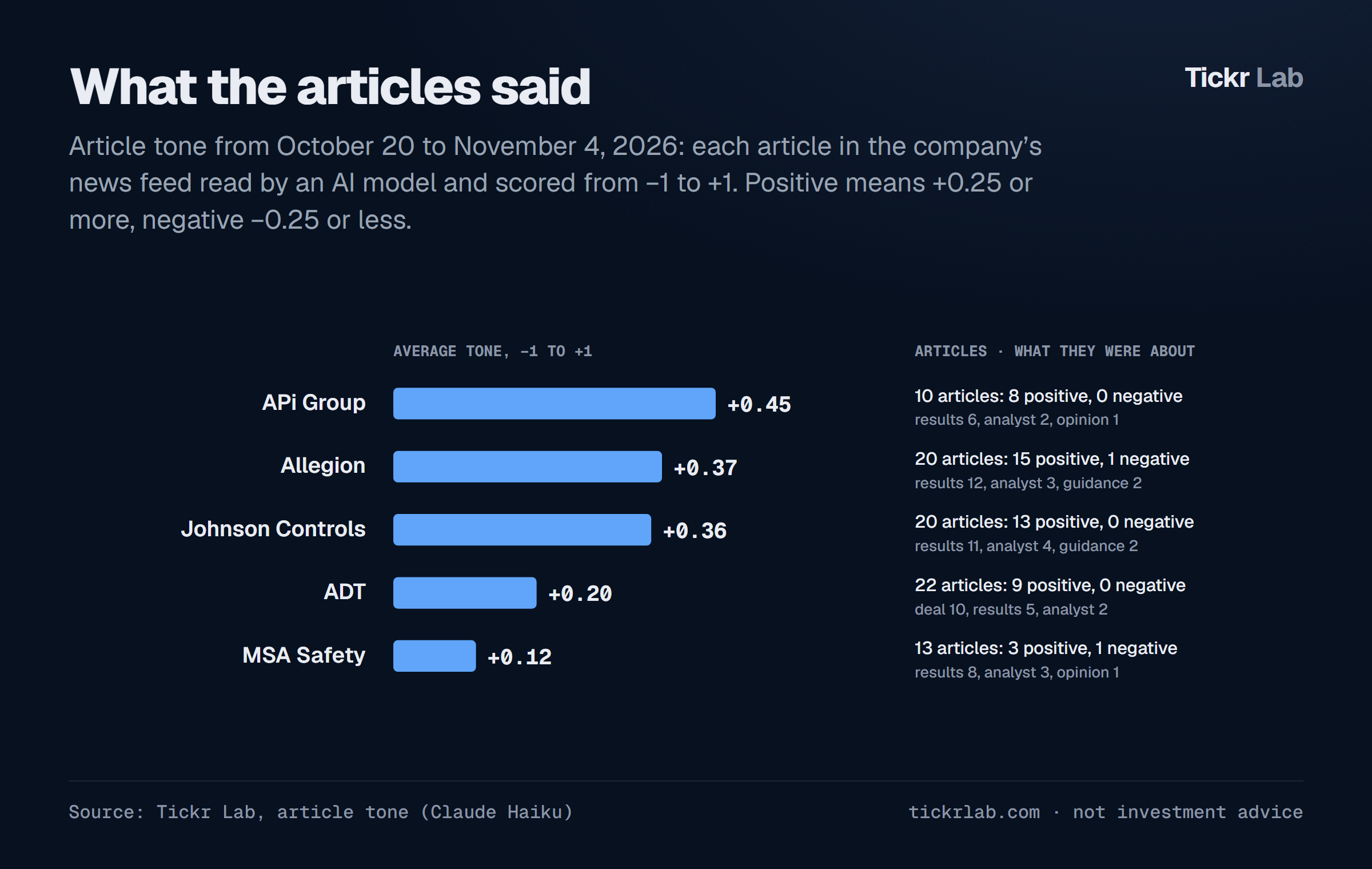
Every article in a company's news feed is read by an AI model, which scores its tone from −1 to +1 and writes a two-sentence summary. Five of the nine have been read through this results season. The four that joined Tickr Lab this week will be read from now on.
- APi Group drew the warmest coverage, +0.45 on average, with eight of ten articles positive. The most positive covered its record third quarter: revenue up 22.5%, 15.7% of it organic, and a raised outlook for the year.
- Allegion (+0.37) and Johnson Controls (+0.36) were close behind, almost all of it results coverage: earnings above estimates and raised or new outlooks. Allegion's one negative article was a valuation commentary.
- ADT's 22 articles were dominated by its sale: ten were about the deal. Bloomberg reported that Apollo Global Management provided about $9.6 billion of debt commitments for Thrive Holdings' purchase, plus some preferred equity. ADT's shares closed at $6.87 on October 27, $7.41 the next day and $9.87 on October 29, the day of the announcement.
- MSA Safety was the coolest, at +0.12, with three positive articles and one negative. Its release reported sales up 15%, 6% organic, with Autronica counted from July 9.
Tone is a reading of what was written, not of the price. Two weeks of articles around results is a short window, and the scores will be worth more as the record grows.
Short sellers, insiders and options
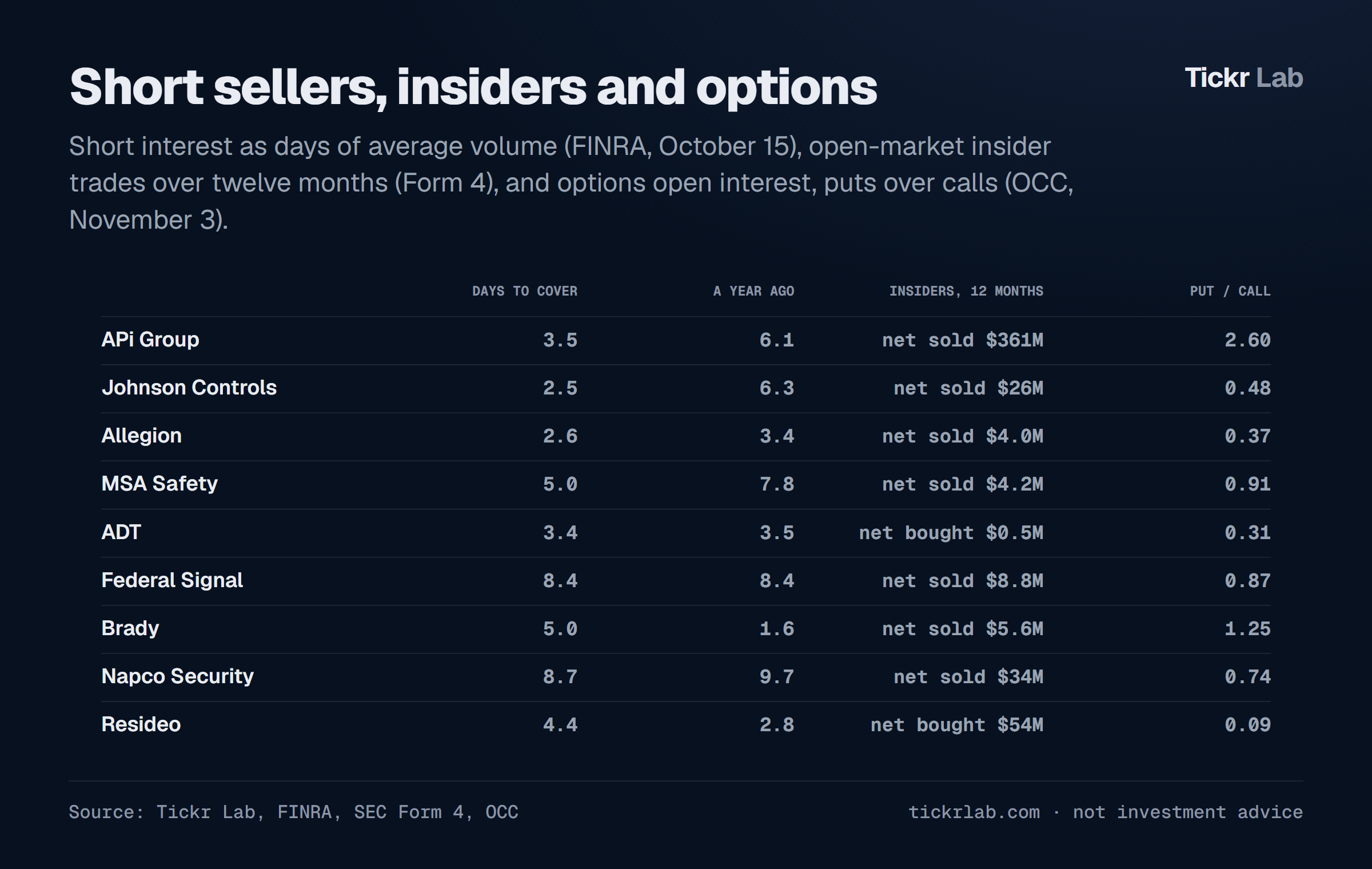
The filings show who has been acting on these companies.
- Short interest fell at most of them. Measured in days of average volume, it roughly halved at Johnson Controls (6.3 days to 2.5, with shares sold short down 57%) and fell at APi Group (6.1 to 3.5) and MSA Safety (7.8 to 5.0). It rose at Brady (1.6 to 5.0) and Resideo (2.8 to 4.4). Napco Security and Federal Signal carry the most, at more than eight days each.
- Insiders mostly sold, with two exceptions. At APi Group, co-founder and director Sir Martin Franklin sold about $239 million of shares over the year, and two other directors sold under pre-arranged trading plans. At Napco Security, founder Richard Soloway sold $31 million. The largest buyer was CD&R Investment Associates, part of the private equity firm Clayton, Dubilier & Rice, which bought $53 million of Resideo as a holder of more than 10%. ADT insiders made six small purchases and no sales.
- Options are mostly calls, except at APi, where puts outnumber calls 2.6 to 1. Nearly all of APi's open puts (10,146 of 11,034) sit in one expiry, November 20, which suggests a single large position rather than broad selling pressure. At Resideo, calls outnumber puts eleven to one.
How far they fell, and how fast they came back
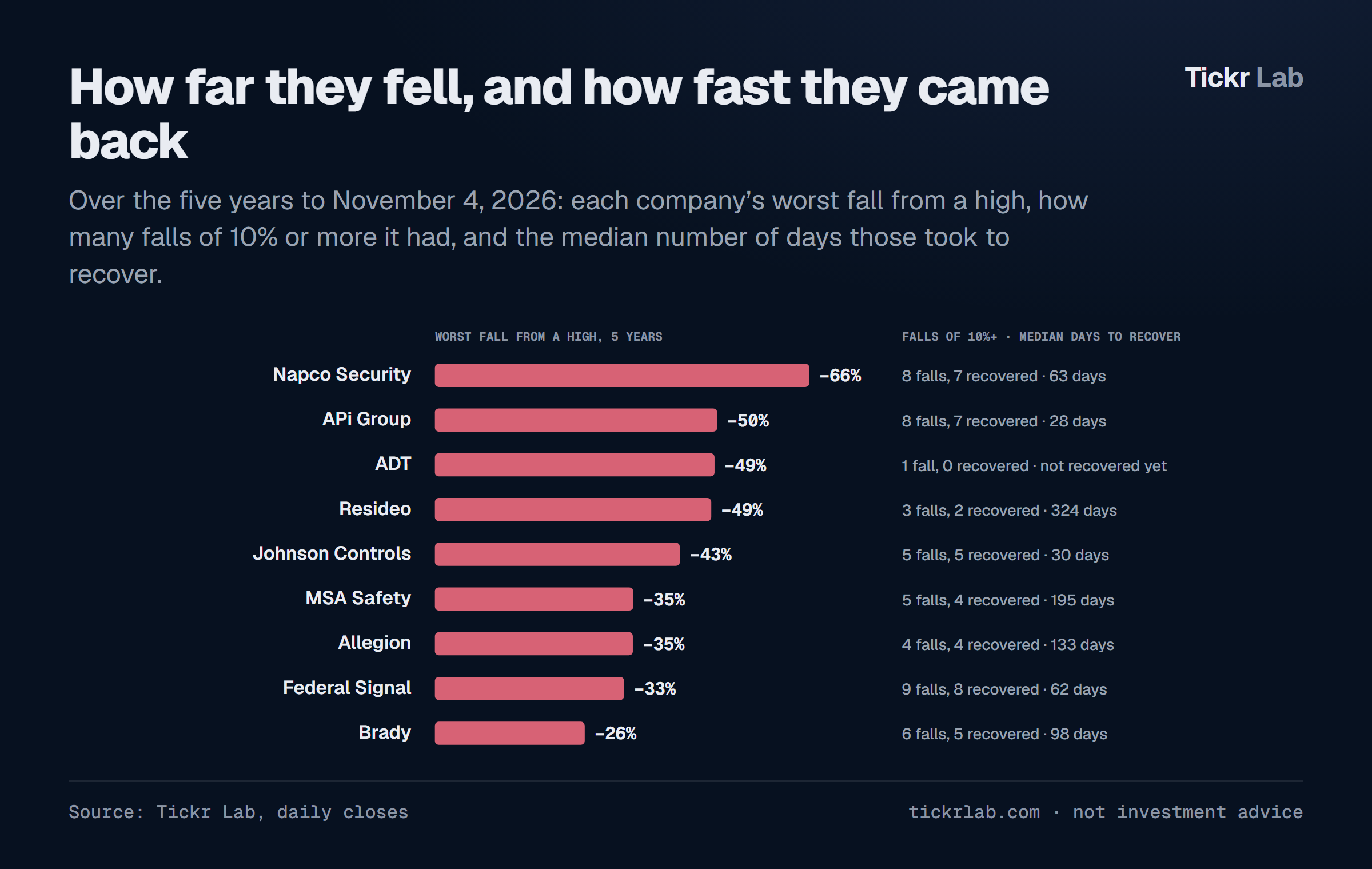
Over five years the nine fell hard at times, and recovered at very different speeds. Napco Security's worst fall from a high was 66%. APi Group fell 50% at worst, yet its falls of 10% or more took a median of only 28 days to recover, the quickest here, with Johnson Controls close at 30. Resideo's took a median of 324 days and MSA Safety's 195. ADT has had one fall of that size in the period, 49%, and is still below the high it fell from. Brady has been the steadiest, at 26% worst.
The Signal, company by company
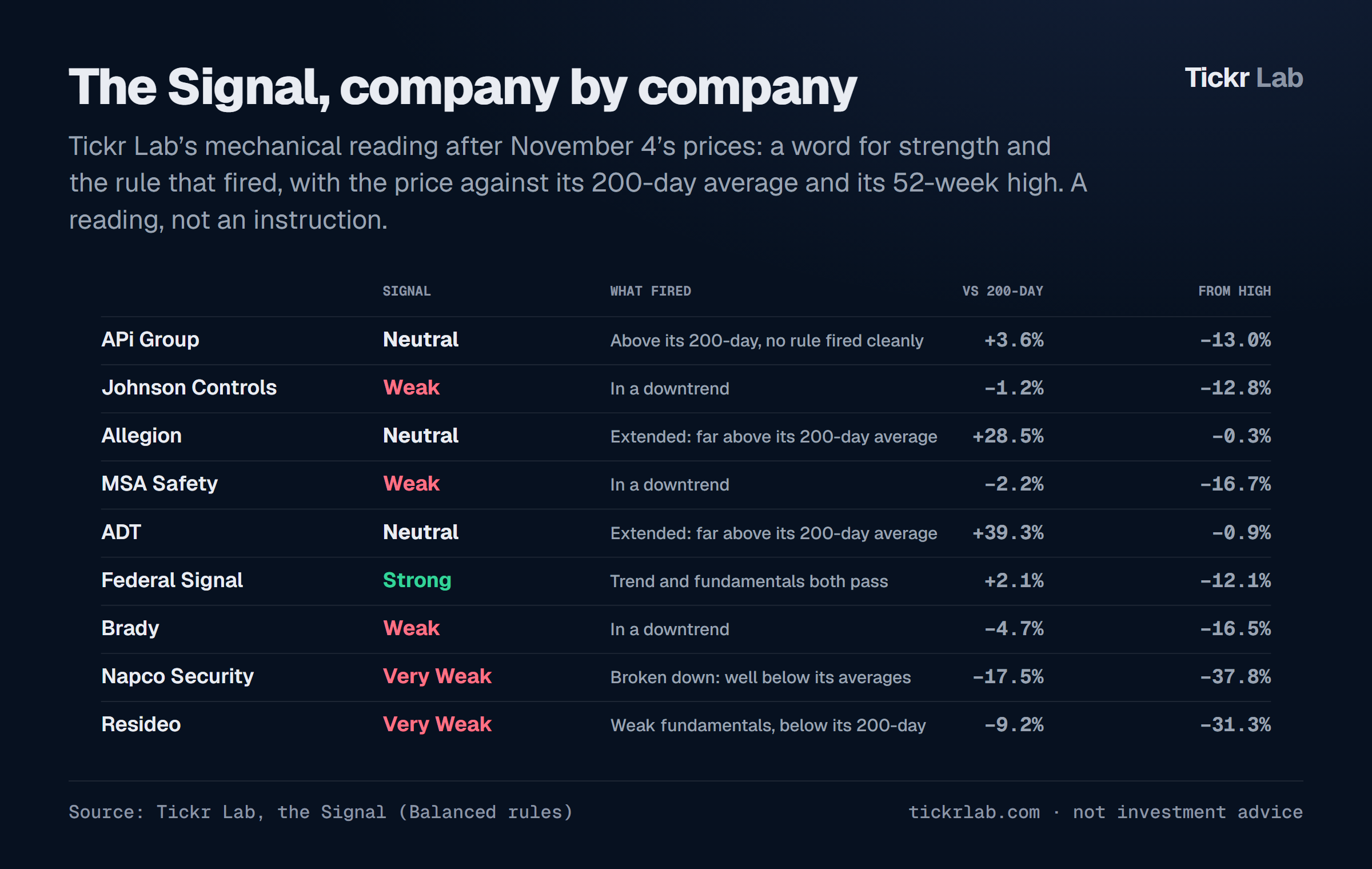
Tickr Lab's Signal is a mechanical reading of strength, with the rule that fired; it is not an instruction to do anything. After November 4's prices:
- Federal Signal reads Strong: its trend and its fundamentals both pass.
- APi Group reads Neutral, above its 200-day average with no rule firing cleanly. Allegion and ADT also read Neutral, under the rule for prices stretched far above their averages: 28.5% and 39.3% above their 200-day averages, both within 1% of their 52-week highs. ADT's price is now set by its agreed $10 sale price.
- Johnson Controls, MSA Safety and Brady read Weak, each in a downtrend and 13% to 17% below its high.
- Napco Security reads Very Weak, broken down after its November 2 report: 17.5% below its 200-day average and 37.8% below its high. Resideo also reads Very Weak, below its 200-day average with weak fundamentals.
Seven of the nine are more than 12% below their 52-week highs. The two near their highs are there for reasons of their own: Allegion after a raised outlook, ADT after its sale.
The next two to five years: what the data lets you watch
An investor with a two-to-five-year horizon cares less about one results day than about where revenue, margins and cash are heading, what the companies have committed to, and how much of that is already in the price. Tickr Lab cannot say what will happen. What it can show is what each company has told the market, how its numbers have moved over several years, and which checkpoints will show whether the story is holding.
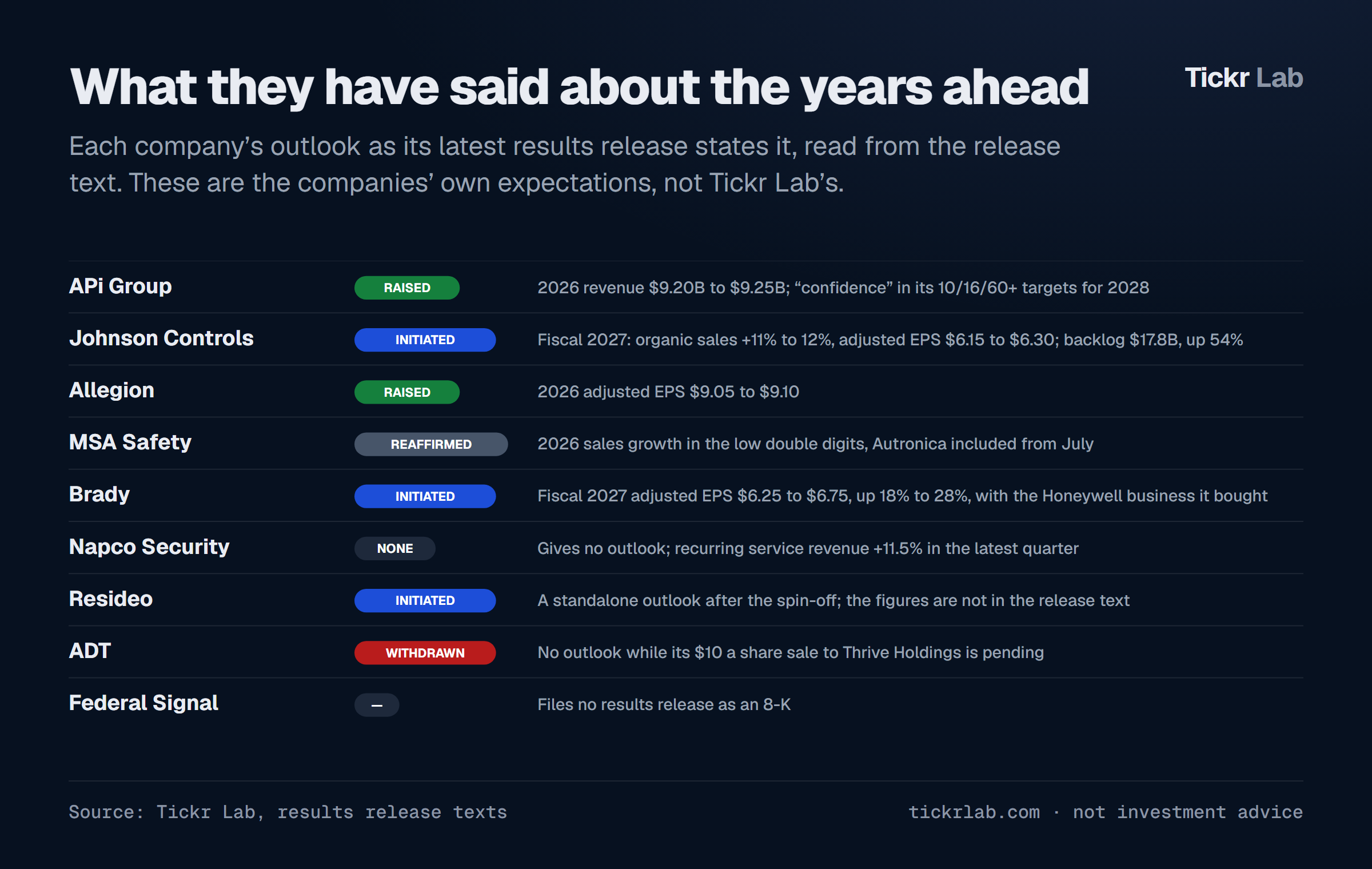
What they have committed to. The release texts carry the companies' own words about the years ahead.
- APi Group raised its 2026 revenue range to $9.20 billion to $9.25 billion and wrote that "the strength we are carrying into 2027" gives it "continued confidence in our ability to deliver on our long-term '10/16/60+' targets", its goals for 2028 (set out in our first post).
- Johnson Controls set fiscal 2027 guidance of 11% to 12% organic sales growth, operating leverage of 30% or more and adjusted EPS of $6.15 to $6.30. It reported orders up 58% and a backlog of $17.8 billion, up 54%, "supported by sustained demand for data centers".
- Brady expects fiscal 2027 adjusted EPS of $6.25 to $6.75, 18% to 28% more than 2026, with Honeywell's Productivity Solutions and Services business, which it agreed to acquire in April, has since completed and now calls Intelligent Productivity Solutions. It also named data center construction as a driver of its sales.
- Allegion raised its 2026 adjusted EPS range to $9.05 to $9.10, and MSA Safety kept its outlook of low double-digit sales growth for 2026.
- Napco Security gives no outlook; ADT withdrew its own when it agreed to its sale; Resideo began giving a standalone outlook after its spin-off.
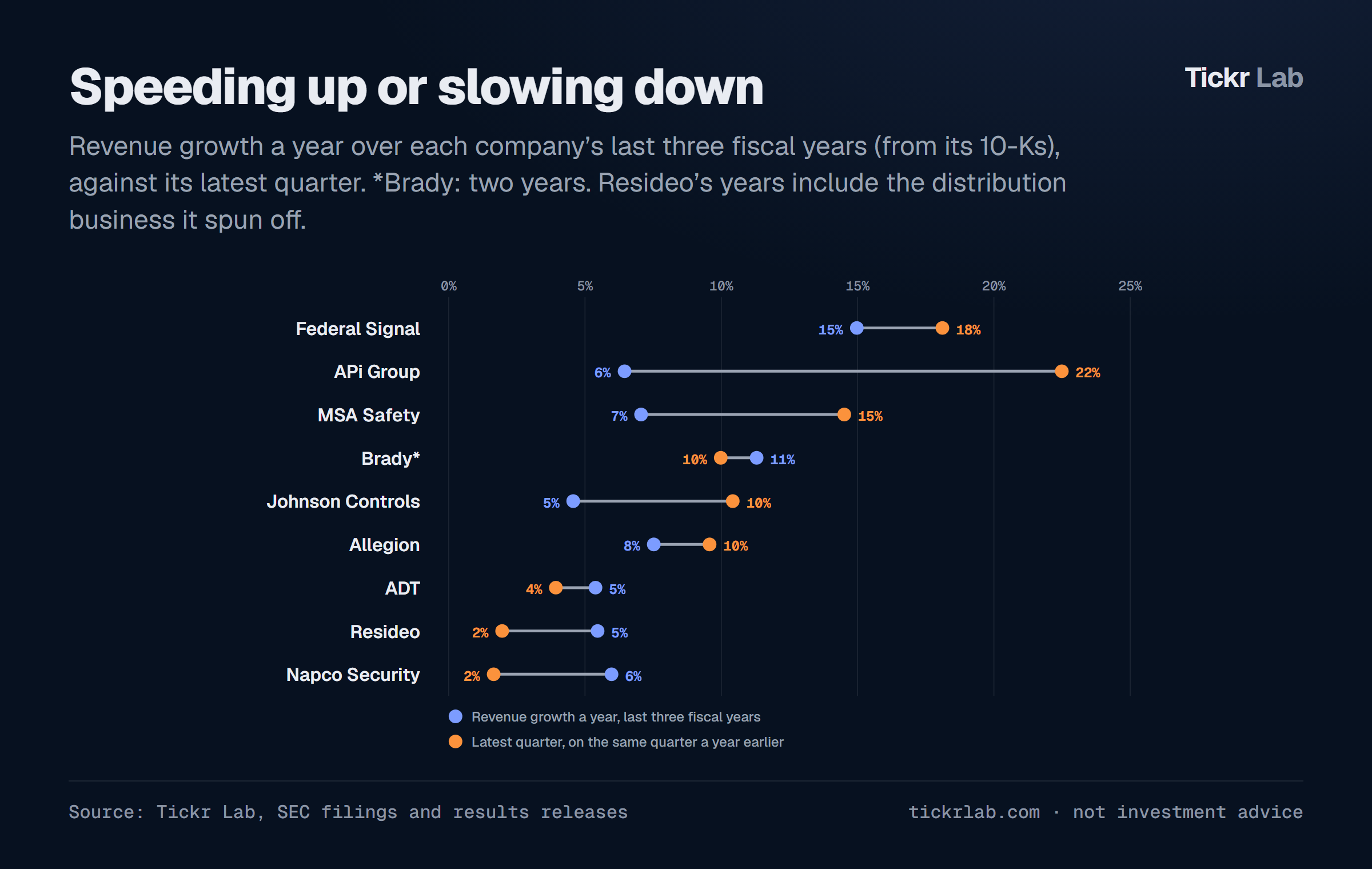
Growth: speeding up or slowing down. Comparing each company's last three fiscal years, from its 10-Ks, with its latest quarter shows the direction of travel. Federal Signal has grown fastest over three years, about 15% a year, and its latest quarter was faster still at 18%. APi Group, MSA Safety and Johnson Controls are growing faster now than over the past three years, although part of APi's 22% and MSA's 15% came from acquisitions (APi's organic growth was 15.7%, MSA's 6%). Napco Security and Resideo are growing more slowly than before, at about 2%.
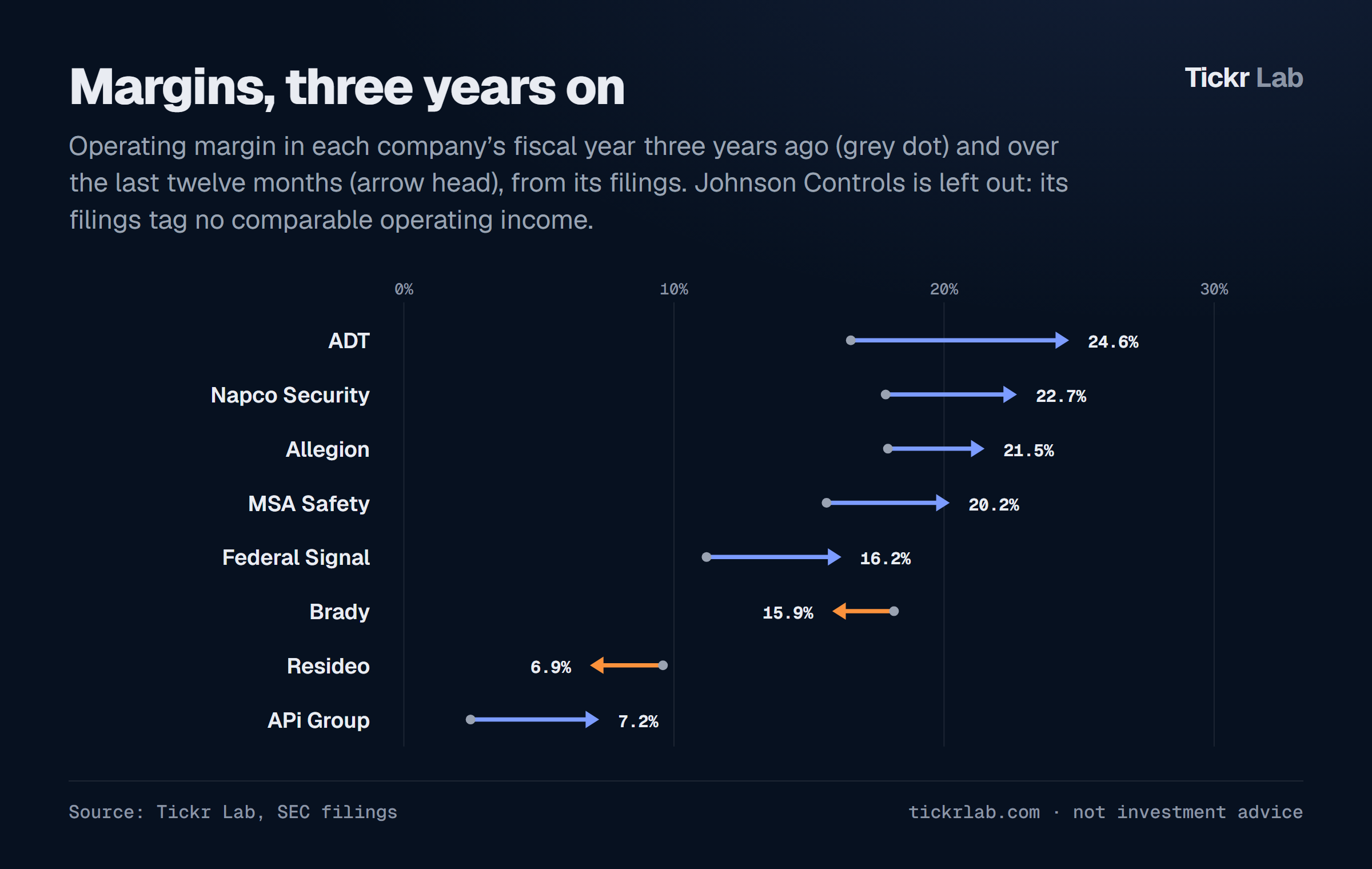
Margins, and what is lifting them. Six of eight companies have wider operating margins than three years ago. Two things in the release texts matter for judging whether that lasts.
- Tariff refunds are flattering 2026. Allegion said tariff refunds added $19.9 million to its third-quarter operating income; MSA Safety said its second-quarter margin "benefited from tariff refunds"; Resideo's second-quarter gross margin included $27 million of them. These are one-off, and margins without them are the better guide to the years ahead.
- Some of the gains come from changing the business. ADT's margin rose as it sold businesses, including its multifamily business in October 2025. Brady's margin fell, and its latest release cites acquisition and integration costs. APi Group's operating margin is low because acquisitions bring large amortization charges; its own adjusted EBITDA margin was 13.4% over the twelve months to September.
Cash. Resideo's free cash flow over the past year is negative because it paid Honeywell $1,590 million in August 2025 to end an indemnification agreement, as its releases set out; in 2026 it made a further payment to end a tax agreement. Measured against the adjusted EBITDA each company reports, net debt is about 2.7 times at APi Group, 1.8 at MSA Safety (after borrowing for Autronica), 1.7 at Johnson Controls and 1.5 at Allegion, while Napco Security holds about $124 million of net cash. ADT's is 2.8 times today, and its buyer's financing adds about $9.6 billion of debt commitments from Apollo.
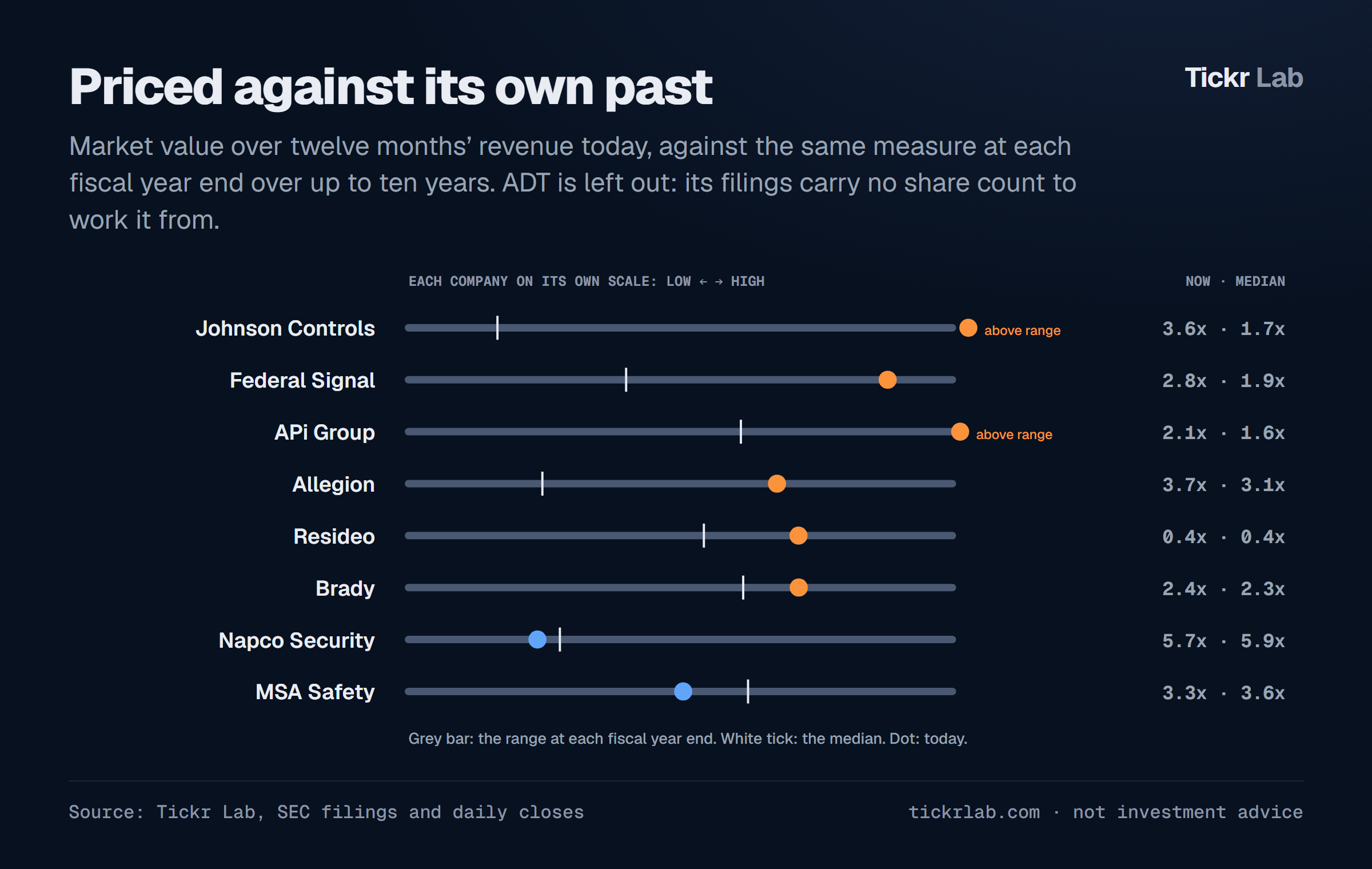
How much is already in the price. Against its own record, Johnson Controls is valued at 3.6 times its revenue, against a median of 1.7 times at its fiscal year ends over ten years and above anything in that range; it has sold businesses over the period, so its revenue base has changed too. APi Group (2.1 times against 1.6) is at the top of its six-year range and Federal Signal (2.8 against 1.9) near the top of its ten. MSA Safety and Napco Security are slightly below their medians. Where the price sits high against its own past, the growth the companies have promised is already part of it; where it sits low, the market is waiting to see it.
Checkpoints Tickr Lab will show each quarter, without anyone having to forecast:
- Whether APi Group's adjusted EBITDA margin keeps rising towards the 16% of its 2028 target, and whether inspection and service keep growing as a share of revenue.
- Whether Johnson Controls' $17.8 billion backlog turns into the 11% to 12% organic growth it has guided for fiscal 2027.
- Whether Napco Security's recurring service revenue, the part with over 90% gross margins, keeps growing by double digits while its equipment sales recover or keep falling.
- How Allegion's, MSA Safety's and Resideo's margins look once the tariff refunds have passed.
- Whether Brady delivers the 18% to 28% earnings growth it expects with its acquisition, and whether MSA Safety gets the roughly 20% EBITDA margin Autronica had before it was bought.
- Whether short interest at Brady and Resideo, which rose over the year, keeps rising, and what insiders, and CD&R at Resideo, do next.
What this is, and what it is not
These are readings of what has happened: prices, filings, articles and positions, measured the same way Tickr Lab measures every company. None of it says where any of these shares go next.
Prices are daily closes to November 4, 2026; the group figures give each company equal weight, and year-by-year returns average the members that traded the whole year (six in 2016 to 2018, eight in 2019 and 2020, nine since). Results-day moves run from the close before the filing day to the close of the session after it, for each company's last ten results releases filed since July 2024; the outlook classification is Tickr Lab's reader's, from the release text. Article tone covers October 20 to November 4, 2026, read by Claude Haiku; the Apollo financing is from Bloomberg's article as it appeared in ADT's feed. Short interest is FINRA's, settled October 15, 2026, against the reading a year earlier; insider figures are open-market purchases and sales reported on Form 4 over the twelve months to November 4; options open interest is the Options Clearing Corporation's for November 3. Drawdowns count falls of 10% or more from a high over five years. The Signal uses the Balanced rules. The forward-looking section quotes the companies' latest results releases from their full text; three-year growth and margins use each company's last three fiscal years as its latest 10-K restates them, and the latest twelve months from Tickr Lab's source rule; price to sales uses the closing price at each fiscal year end and that year's diluted share count, adjusted for APi's 3-for-2 split in July 2025; net debt to adjusted EBITDA uses the September balance sheets and the companies' own adjusted EBITDA for the four quarters to September.